From new stealth bombers to AI-enabled drones, the U.S. and China are reshaping airpower for a Pacific showdown – each betting its technology can keep the other out of the skies.
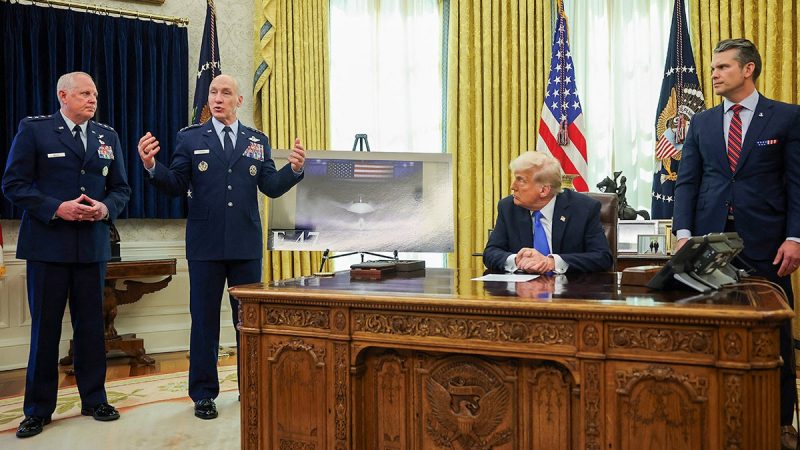
The U.S. is charging ahead with its next-generation F-47 fighter, while China scrambles to catch up with jets designed to match the F-35 and F-22.
After a brief program pause in 2024, the Air Force awarded Boeing the contract in March for the F-47, a manned sixth-generation fighter meant to anchor America’s next air superiority fleet. The first flight is expected in 2028.
At the same time, the B-21 Raider, the stealth successor to the B-2, is deep into testing at Edwards Air Force Base. The Air Force plans to buy at least 100 Raiders – each built to survive inside heavily defended Chinese airspace.
The Pentagon is also betting on Collaborative Combat Aircraft, or CCAs – drones designed to fly alongside fighters as ‘loyal wingmen.’ Prototypes from Anduril and General Atomics are already in the air. Officials say CCAs will let one pilot control several drones at once.
China outpaces the rest of the world in the commercial drone market, but that doesn’t necessarily give it the advantage from a military perspective.
‘I’m not sure that’s really true. In terms of high-end military drones that are really important to this fight, the U.S. still has a pretty significant edge.’ said Eric Heginbotham, a research scientist at MIT’s Center for International Studies.
He pointed to the Air Force’s stealth reconnaissance platforms – the RQ-170 and RQ-180 – and upcoming ‘loyal wingman’ drones designed to fly with fighters as proof that the U.S. still leads in advanced integration and stealth technology.
China’s leap forward
China’s airpower modernization has accelerated as the U.S. reshapes its force. Beijing has zeroed in on three priorities – stealth, engines and carriers – the areas that long held its military back.
The Chengdu J-20, China’s flagship stealth fighter, is being fitted with the new WS-15 engine, a home-built powerplant meant to rival U.S. engines.
‘It took them a while to get out of the blocks on fifth generation, especially to get performance anywhere near where U.S. fifth gen was,’ Heginbotham said. ‘The J-20 really does not have a lot of the performance features that even the F-22 does, and we’ve had the F-22 for a long time.’
Meanwhile, China’s third aircraft carrier, the Fujian, was commissioned this fall – the first with electromagnetic catapults similar to U.S. Ford-class carriers. The move signals Beijing’s ambition to launch stealth jets from sea and project power well beyond its coast.
Together, the J-20, the carrier-based J-35, and the Fujian give China a layered airpower network – stealth jets on land and at sea backed by growing missile coverage.
Chinese military writings identify airfields as critical vulnerabilities. PLA campaign manuals call for striking runways early in a conflict to paralyze enemy air operations before they can begin. Analysts believe a few days of concentrated missile fire could cripple U.S. bases across Japan, Okinawa and Guam.
‘The U.S. bases that are forward deployed – particularly on Okinawa, but also on the Japanese mainland and on Guam – are exposed to Chinese missile attack,’ said Mark Cancian, a retired Marine colonel and senior advisor at the Center for Strategic and International Studies. ‘In our war games, the Chinese would periodically sweep these air bases with missiles and destroy dozens, in some cases even hundreds, of U.S. aircraft.’
Heginbotham said that missile-heavy strategy grew directly out of China’s early airpower weakness.
‘They didn’t think that they could gain air superiority in a straight-up air-to-air fight,’ he said. ‘So you need another way to get missiles out – and that another way is by building a lot of ground launchers.’
Different strategies, same goal
The two militaries are taking different paths to the same target: air dominance over the Pacific.
The U.S. approach relies on smaller numbers of highly advanced aircraft linked by sensors and artificial intelligence. The goal: strike first, from long range, and survive in contested skies.
China’s model depends on volume – mass-producing fighters, missiles, and carrier sorties to overwhelm U.S. defenses and logistics.
‘U.S. fighter aircraft – F-35s, F-15s, F-22s – are relatively short-legged, so they have to get close to Taiwan if they’re going to be part of the fight,’ Cancian said. ‘They can’t fight from Guam, and they certainly can’t fight from further away. So if they’re going to fight, they have to be inside that Chinese defensive bubble.’
Both sides face the same challenge: surviving inside that bubble. China’s expanding missile range is pushing U.S. aircraft farther from the fight, while American bombers and drones are designed to break back in.
The fight to survive
Heginbotham said survivability – not dogfighting – will define the next decade of air competition.
‘We keep talking about aircraft as if it’s going to be like World War II – they go up, they fight each other. That’s not really our problem,’ he said. ‘Our problem is the air bases themselves and the fact that aircraft can be destroyed on the air base.’
China, he warned, is preparing for that reality while the U.S. is not.
‘They practice runway strikes in exercises, they’re modeling this stuff constantly,’ Heginbotham said. ‘Unlike the United States, China is hardening its air bases. The U.S. is criminally negligent in its refusal to harden its air bases.’
Cancian’s war-game findings echo that vulnerability. He said U.S. surface ships and aircraft would likely have to fall back under missile fire in the opening days of a conflict.
‘At the initial stages of a conflict, China would have a distinct advantage,’ Cancian said. ‘Now, over time, the U.S. would be able to reinforce its forces, and that would change.’
Looking ahead
The Pentagon’s fiscal 2026–27 budget will determine how fast the U.S. can build out its F-47s, B-21s and CCAs – systems that will shape American airpower through the 2030s.
China’s rapid modernization is closing what was once a wide gap, but the U.S. still holds advantages in stealth integration, combat experience and autonomous systems.
‘The ability to protect our aircraft, whatever form those aircraft take, on the ground is going to be central to our ability to fight in the Asia theater,’ Heginbotham said.
‘Survivability is going to be key… The ability to protect and disperse your firepower is going to be central to whether we can really stay in this game.’
For decades, U.S. air dominance was taken for granted. In the Pacific, that advantage is no longer guaranteed.
