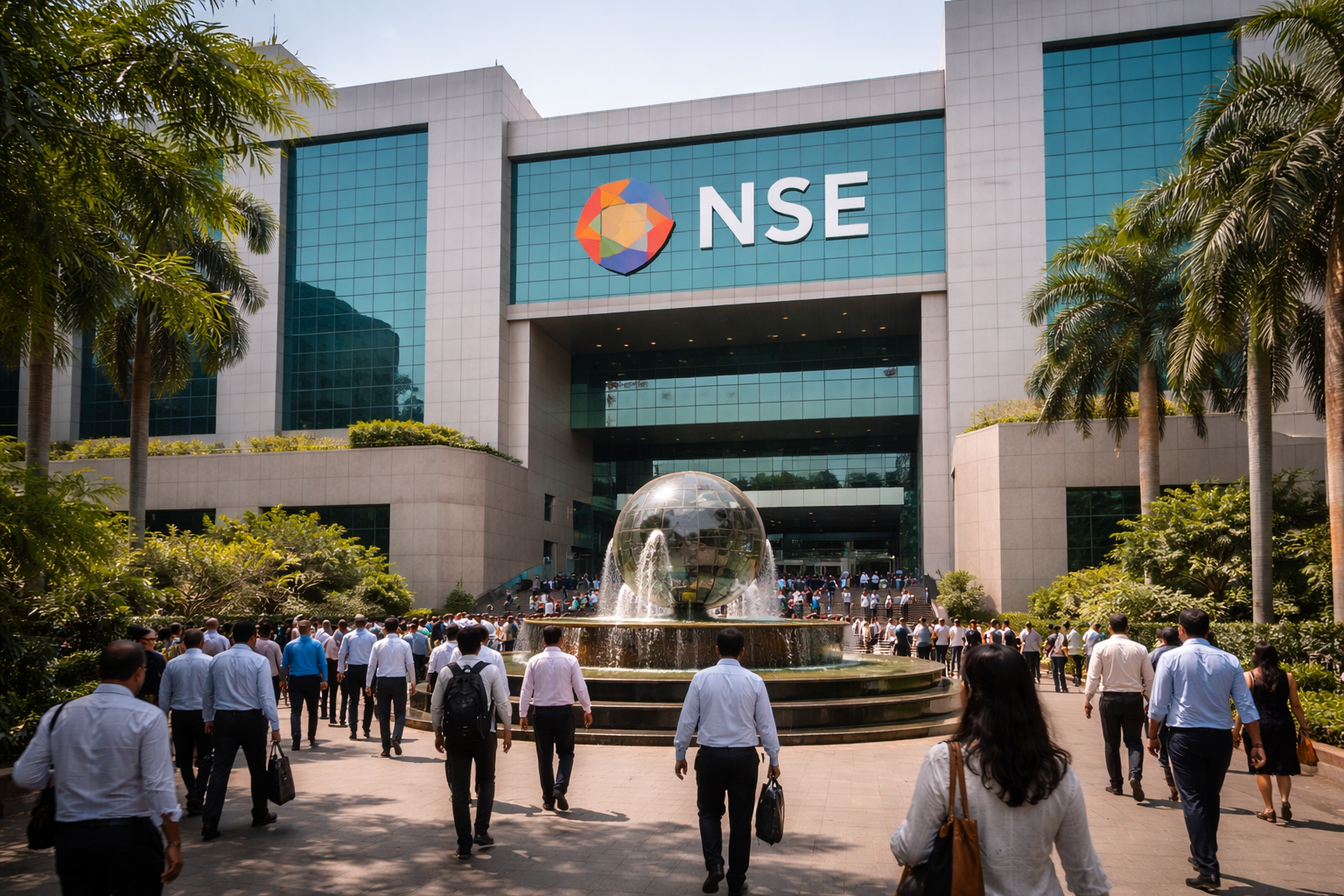
The dark clouds persist over Indian markets.
The Nifty 50 has declined nearly 14% in 2026.
The US-Iran conflict has spooked the energy markets, which in turn has increased inflation worries for the country due to its energy needs and dependence on the Middle East.
In this perfect storm, where can investors find solace or shelter?
Where are the returns?
On Monday, the Nifty 50 fell 2.6% after US President Donald Trump issued an ultimatum to Iran over the Strait of Hormuz on Saturday.
The index had fallen 3.26% on 19th March, its biggest intraday fall since June 2024.
Sagar Lele, Executive Director, Paterson attributed the fall to the geopolitical tensions and the fall of HDFC Bank shares which has a huge weightage in the index.
The index has now logged 4 consecutive weeks of decline.
Foreign investors have pulled out more than ₹80,000 crore in March, leaving Indian investors with heavy losses and heightened volatility.
Karthick Jonagadla, Founder and CEO, Quantace Research and Capital, said that Nifty is no longer a ‘buy every dip’ market. It is a ‘price risk first, narrative later’ market.
He pointed out that India VIX is above 22 compared to its 52-week low of 8.72, showing how much volatility the market is pricing in.
Jonagadla also indicated the broader market impact of sustained foreign outflows.
“With reported foreign equity outflows of ₹3 trillion in 2025, another ₹41,300 crore sold in January 2026, and roughly ₹81,262 crore pulled from equity in March, the issue is bigger than stock prices. The real transmission is through the rupee, liquidity, and weaker valuation support for crowded benchmark names.” he added.
How oil sinks the Indian economy
The conflict has shown how dependent India is on energy sources coming from the Middle East.
India imports 90% of the crude it needs and around 45-50% of it is sourced from the Middle East.
In terms of LPG, it sources 90% of its imports from the Middle East.
The disruptions at the Strait of Hormuz caused an LPG shortage around the country, affecting eateries and restaurants.
Lele said, “Gas supply disruptions tend to have a more immediate impact compared to oil. While India typically maintains oil inventories for about 50–55 days, gas storage capacity is much more limited. As a result, any supply shock quickly affects industries, even though domestic consumption remains relatively stable.”
He added that there were early signs of the impact when Qatar Energies temporarily halted gas supplies led to industrial shutdowns in places like Morbi in Gujarat.
Jonagadla said that a rise in the brent crude prices will put pressure on India’s inflation.
“Headline CPI at 3.21% is still contained, but the real risk for India is imported inflation. If every $10 rise in crude adds about 55–60 bps to CPI, then higher oil can quickly narrow RBI easing room, weaken the rupee, and squeeze margins in fuel-intensive sectors.” he added.
Where can investors find solace?
While the index had recovered on Friday and Gift Nifty Futures gained 3.7% on Monday in after-market trading as Trump said the US and Iran held productive talks.
Lele said not to read much into sharp movements at present.
“From an investment perspective, trying to predict the exact bottom or timing of recovery is not particularly useful right now. There are too many variables at play, most of which are uncertain, making such predictions largely futile.”
Even as safe-haven assets such as gold have shown weakness, market participants say the focus should remain on discipline rather than reaction.
Lele advised investors to avoid panic-driven decisions despite the heightened volatility. “The primary advice we are giving clients is to avoid panic selling. Many of our clients, particularly High-Net-Worth Individual (HNI), are experienced investors and understand the importance of staying invested through volatility,” he said.
For those sitting on cash, he recommended a staggered deployment strategy. “A practical approach is to divide the investment amount into three or four tranches and invest incrementally, especially during market dips. This reduces timing risk and allows investors to benefit from volatility without trying to perfectly time the bottom,” he added.
IT to be the dark horse?
On sectors, Lele pointed to pockets of resilience emerging amid the broader uncertainty.
He said the FMCG space could benefit from early signs of a pickup in domestic consumption.
Power stocks are also on his radar, supported by rising demand, particularly with the onset of an early summer when electricity consumption typically peaks.
He also remained constructive on Indian IT despite recent underperformance and concerns around artificial intelligence disrupting traditional business models.
“There have been a lot of fundamental questions about the business model over the last couple of months, where IT stocks get bashed up whenever Anthropic puts out a press release,” he said.
However, Lele argued that the pessimism appears overdone.
Strong order books and the performance of global peers such as Accenture do not point to a structural decline.
He noted that Indian IT has consistently adapted across cycles—from BPO services to digital transformation—and is well-positioned to participate in AI-led demand, particularly in integration and development. “We do not see a long-term existential threat to the sector,” he said.
From a risk perspective, Jonagadla’s framework highlights how uneven the impact of the current environment could be across sectors.
“On our 10-point stress score, aviation (9.5) and oil marketing companies, or OMCs (9), are the most exposed,” he said, adding that autos, discretionary consumption, and even private financials face elevated risk levels.
He noted that private banks, in particular, are vulnerable more as proxies for foreign investor selling rather than due to any underlying balance sheet stress.
At the same time, he identified a basket of relatively safer sectors where investors could look for stability. “Our relative safety basket is led by pharma and healthcare (8.5/10), followed by FMCG (8), utilities and defense (7.5), and large export-oriented tech (7),” Jonagadla said.
The rationale, he explained, lies in the nature of demand and earnings resilience.
These sectors typically offer defensive demand, better pricing power, or natural hedges through export earnings.
“Defensiveness is now about drawdown control rather than valuation comfort,” he added. “These sectors may not look optically cheap, but they should hold earnings better and suffer less valuation damage than oil-sensitive domestic cyclicals if macro stress persists.”
For now, analysts say the market is likely to reward resilience over risk-taking, with cash flows and earnings visibility taking precedence over high-growth narratives in an increasingly uncertain macro environment.
The post What’s next for Indian markets after recent selloff? appeared first on Invezz
