America’s allies, grappling with surging energy costs triggered by Washington’s military strikes on Iran and the resulting disruption in global supply chains, are confronting a strategic dilemma.
The crisis has highlighted the need to move away from volatile fossil fuel markets.
However, it has also exposed a new risk, as energy security increasingly depends on China, a dominant player in clean technology and critical minerals.
War-driven energy crisis accelerates clean transition
From the European Union and the United Kingdom to South Korea and the Philippines, governments have responded to the spike in oil and gas prices with renewed calls to accelerate electrification and expand clean energy infrastructure.
The immediate trigger has been the disruption in energy flows following the effective blockage of the Strait of Hormuz, a chokepoint for global oil and liquefied natural gas shipments.
Nations heavily dependent on Middle Eastern energy imports have scrambled to contain the fallout, adopting short-term conservation measures while fast-tracking long-term energy transition plans.
Solar and wind installations, battery storage systems, and electric vehicle adoption are being pushed to the forefront of policy agendas.
Governments see domestically generated renewable energy and nuclear power as the most viable way to shield their economies from the geopolitical volatility that has long defined fossil fuel markets.
China’s dominance looms over decarbonisation push
However, the shift toward clean energy comes with a significant caveat.
The faster countries attempt to decarbonise, the more they risk deepening their dependence on China.
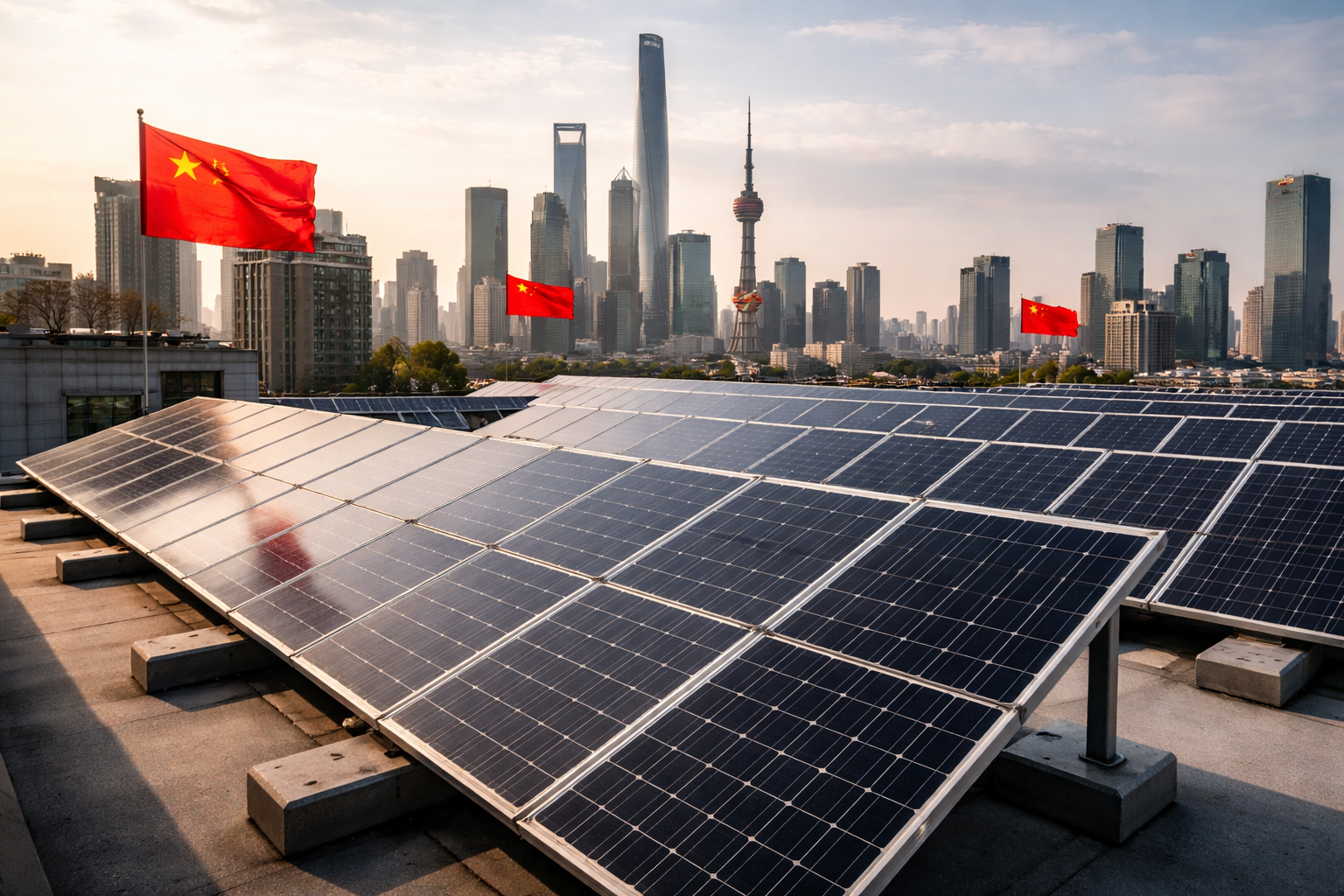
Beijing commands an overwhelming share of the global supply chain for clean technologies.
It produces nearly 80% of the world’s solar panels and dominates the manufacturing of critical components such as wafers and cells, according to the International Energy Agency.
Its footprint extends across batteries, electric vehicles, and grid infrastructure.
Even in wind turbines, where Europe retains a foothold, China still controls around 60 percent of output.
“China is the clear winner,” said David M. Hart, a senior fellow for climate and energy at the Council on Foreign Relations.
He noted that Beijing’s advantage goes beyond individual industries, encompassing broader manufacturing ecosystems and next-generation energy technologies.
Critical minerals tighten Beijing’s grip
Beyond manufacturing, China’s dominance extends into the upstream supply of critical minerals essential for the energy transition.
The country refines roughly 90% of the world’s rare earth elements, which are vital for wind turbines and electric vehicles, and processes a majority share of lithium, cobalt, and other battery metals.
This control gives Beijing significant leverage over global supply chains.
Last year, China imposed export restrictions on several rare earths in response to US tariffs, highlighting the geopolitical risks embedded in the clean energy transition.
At the same time, concerns have emerged over cybersecurity and infrastructure vulnerabilities linked to Chinese-made components.
Reports of unexplained communication devices in solar equipment have further amplified unease among policymakers.
Philippines exemplifies immediate impact
The Philippines offers a stark example of how the crisis is reshaping energy policy.
With approximately 98% of its oil imported from the Middle East, the country was among the first to declare an energy emergency following the disruption.
Authorities introduced a four-day work week to curb consumption and have moved quickly to accelerate renewable energy projects.
Developers report that regulatory approvals, which previously took months, are now being granted within days.
“This is not theory — this is actually happening on the ground now,” said Rahul Agrawal, the developer of one of the largest projects in a WSJ report.
Yet the pivot toward renewables is likely to increase Manila’s reliance on Chinese technology, even as tensions persist between the two countries over territorial disputes in the South China Sea.
Countries seek closer engagement with Beijing
Despite strategic concerns, countries are increasingly engaging with China to secure access to clean technologies and raw materials.
European leaders have been particularly active.
Germany’s economy minister is expected to visit Beijing soon, following recent trips by the country’s chancellor and environment minister aimed at strengthening economic ties.
Spain’s Prime Minister Pedro Sánchez has made multiple visits in recent years to secure critical resources.
Leaders from Canada, Finland, Ireland, and the United Kingdom have also sought closer engagement, while non-Western nations are following suit.
An Indian business delegation recently explored green energy partnerships in China, and the United Arab Emirates has discussed deeper cooperation on energy with Beijing.
Even countries under economic pressure, such as Cuba, have turned to Chinese solar technology to offset supply constraints.
Protectionism rises amid industrial fears
At the same time, governments are attempting to balance access to Chinese technology with the need to protect domestic industries.
The European Union has introduced tariffs on Chinese electric vehicles and steel, while the United States has imposed a 100% tariff on Chinese EV imports.
Several Asian economies have adopted similar measures or introduced local content requirements.
New industrial policies in Europe aim to ensure that a portion of demand for green technologies is met through domestic production by 2030.
Proposals under discussion include caps on foreign investment from countries that dominate global manufacturing in clean technologies.
The United Kingdom has also taken a cautious approach, blocking a Chinese firm from building a major wind turbine factory over national security concerns.
Trade-offs threaten pace of transition
These protective measures come with economic trade-offs.
Domestic production tends to be more expensive than importing Chinese goods, potentially slowing the rollout of clean energy infrastructure.
“If you tilt too much towards domestic production, that might come at the expense of the speed of decarbonisation,” said Simone Tagliapietra, a senior fellow at Brussels-based think tank Bruegel in a Politico report.
The dilemma underscores a broader reality: achieving a rapid energy transition without some degree of reliance on China is proving exceedingly difficult.
Climate gains offset by short-term emissions risks
In the long term, the global diffusion of China’s clean energy technologies is expected to reduce greenhouse gas emissions.
Electric vehicles and renewable power systems offer clear advantages over fossil fuel-based alternatives.
However, the near-term outlook is more complex.
Rising electricity demand driven by electrification could increase reliance on coal, particularly in China, where coal still plays a central role in power generation and industrial activity.
Meanwhile, the conflict has disrupted another key pathway for emissions reduction.
The shift from coal to liquefied natural gas, once seen as a transitional solution, is likely to slow significantly.
Damage to LNG infrastructure in Qatar could take years to repair, while the psychological impact of supply disruptions may linger even longer.
The post How the energy crisis from Iran war is boosting China’s edge in global clean tech appeared first on Invezz
