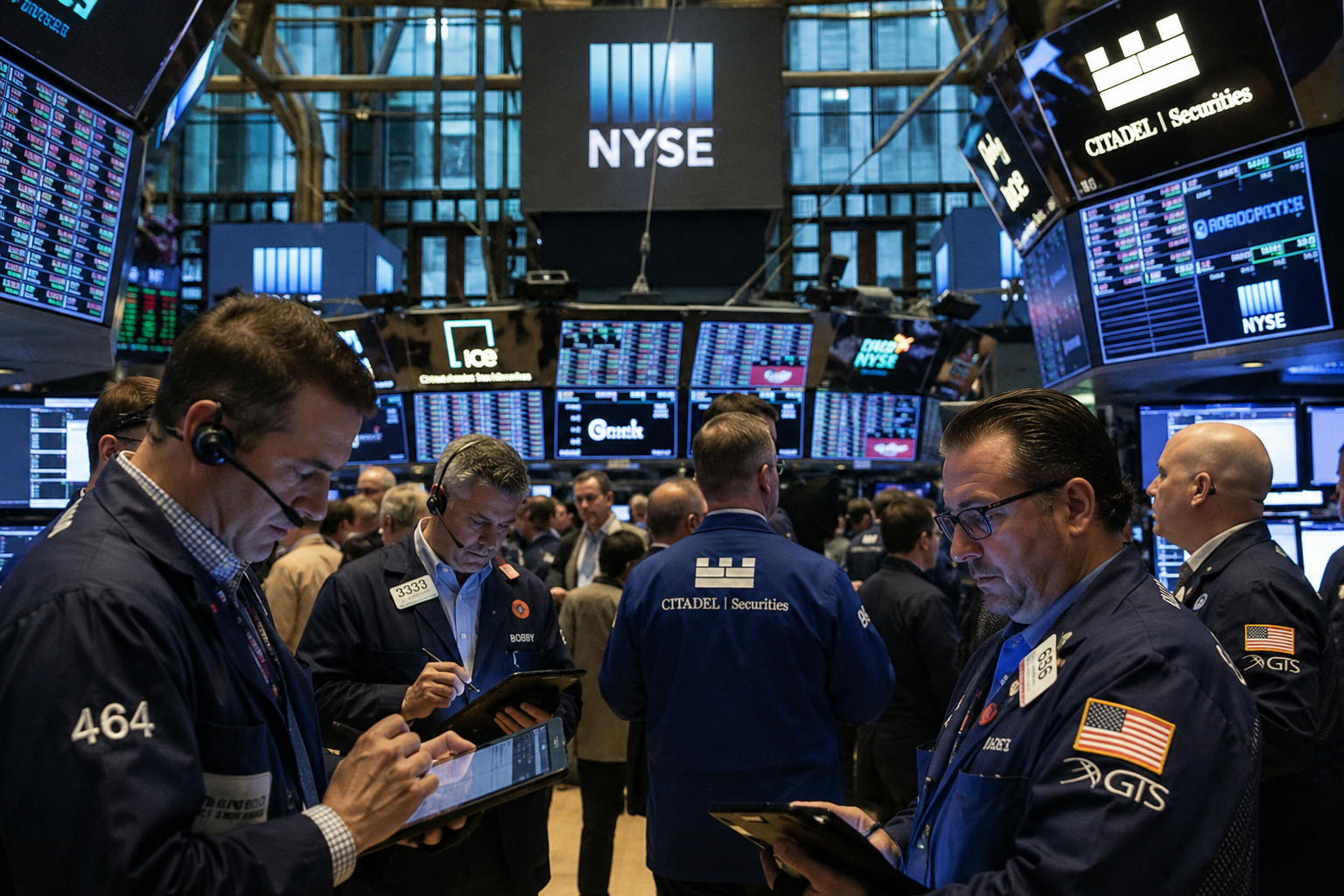
Artificial intelligence has remained one of the strongest investment themes in global markets this year, but recent swings in technology stocks have prompted strategists to caution investors against becoming overly concentrated in the trade.
Last week marked one of the sharpest bouts of volatility for AI-linked stocks in months, as investors questioned the sustainability of surging spending on AI infrastructure, increasing reliance on debt financing and the possibility that higher technology costs could fuel inflation.
The concerns spread quickly across global markets, triggering sharp declines in several technology-heavy indexes before intermittent rebounds.
South Korea’s benchmark KOSPI index, which has nearly doubled this year, plunged as much as 10% in a single session last Tuesday before recovering part of its losses.
Despite the rebound, the index still finished the week down 7%, its steepest weekly decline since early March, when geopolitical tensions surrounding the Iran conflict unsettled markets.
In the United States, the Nasdaq Composite fell 2.2% last Tuesday.
Although stronger-than-expected earnings from memory-chip maker Micron Technology briefly improved sentiment on Wednesday, optimism faded after Apple announced price increases for iPads and MacBooks, citing rising memory and storage costs.
The Nasdaq ultimately ended the week down 4.6%, while several AI-related stocks came under pressure.
Markets began the month of July on a volatile pitch too.
Micron and SanDisk each fell more than 10% on Wednesday as investors locked in profits, while Nvidia declined about 1.25%.
Kospi too again slumped by over 7% today as volatility in South Korea’s equity market continued.
Crowded AI positioning raises risks
Market strategists continue to view artificial intelligence as one of the defining long-term investment themes.
However, Charu Chanana, chief investment strategist at Saxo, said investors now face a different challenge.
“AI is still one of the most important long-term investment themes in markets. But for investors, the question is no longer just whether AI will change the world. It is whether too much of their portfolio is now exposed to the same AI trade,” she wrote.
Chanana noted that many of the market’s strongest performers—including semiconductor companies, memory-chip makers, mega-cap technology firms and AI infrastructure stocks—have attracted significant investor interest, making the trade increasingly crowded.
“Some days, Nasdaq and semiconductor stocks rally sharply. Other days, one capex headline, margin concern or earnings disappointment can drag the whole trade lower,” she said.
The growing concentration has made technology stocks more vulnerable to sharp swings whenever investors reassess AI spending, valuations or corporate earnings.
UBS recommends diversifying into defensive segments within AI
UBS said it continues to favor companies supplying the infrastructure behind artificial intelligence, arguing that earnings momentum and demand remain supportive despite recent volatility.
“We still favor the ‘picks and shovels’ of the AI buildout in our tactical positioning, as demand visibility, pricing power, and earnings momentum remain strong. But recent market volatility has also pointed to certain risks worth monitoring,” the brokerage said.
UBS believes AI-related investments will continue to be a key driver of long-term equity performance but argued that investors should broaden their exposure instead of relying heavily on a handful of technology names.
“For investors, we believe that exposure to AI-related stocks will remain a key differentiator for equity market performance over the long run, but we also believe diversification, both within and beyond AI, is essential,” the firm said.
UBS recommended considering more defensive segments within the AI ecosystem, including data center operators and selected payment companies.
The brokerage also suggested complementing equity holdings with capital preservation strategies to help navigate periods of elevated volatility.
Saxo lays out five strategies to manage AI volatility
Chanana argued that investors do not need to abandon artificial intelligence altogether but should build “shock absorbers” into their portfolios to reduce dependence on a single investment theme.
Her first recommendation is to rebalance positions that have become disproportionately large following the AI rally.
If AI, semiconductor or mega-cap tech exposure has grown too large after the rally, investors can trim it back to their intended portfolio weight. This is not a bearish call on AI. It is basic risk control. Rebalancing helps prevent one theme from hijacking the whole portfolio.
Charu Chanana
Chief Investment Strategist, Saxo
She also recommended rotating part of portfolios toward defensive growth sectors such as healthcare and utilities that can help portfolios behave better when AI volatility spikes.
“These sectors have different earnings drivers from technology and may offer more resilience if the market starts questioning AI valuations or capex expectations,” she said.
Another suggestion is to increase exposure to cheaper, non-AI earnings exposure.
“Financials and selected materials offer exposure to parts of the market where valuations are lower and expectations are less stretched. These sectors do not replace AI, but they can help broaden the earnings base of a portfolio,” she said.
Chanana further advised reducing concentration in mega-cap technology stocks by considering equal-weight equity strategies, limiting dependence on a small number of companies that increasingly dominate capitalization-weighted indexes.
“Equal-weight equity exposure can keep investors invested in the market, while reducing reliance on the biggest AI-linked names,” she said.
Finally, she encouraged investors to adopt dollar-cost averaging (DCA) through regular investments instead of attempting to time volatile markets.
“When volatility is high, timing the perfect entry point becomes almost impossible. Dollar-cost averaging (DCA), or investing a fixed amount regularly, can help investors avoid putting all their money to work at market highs,” she said.
The benefit is simple: investors can keep participating in long-term themes, while reducing the emotional pressure of deciding whether today is a “good” or “bad” day to invest.
Charu Chanana
Chief Investment Strategist, Saxo
Where the re-rating opportunity may be
The most effective hedges are not purely defensive—they should also have the potential to generate returns, Chanana said.
That is where valuations become important. Based on forward price-to-earnings ratios and earnings estimates, several sectors outside AI may offer a more attractive combination of resilience and upside potential.
Source: Saxo
The post AI trade is turning increasingly volatile: experts suggest ways to manage the risk appeared first on Invezz
