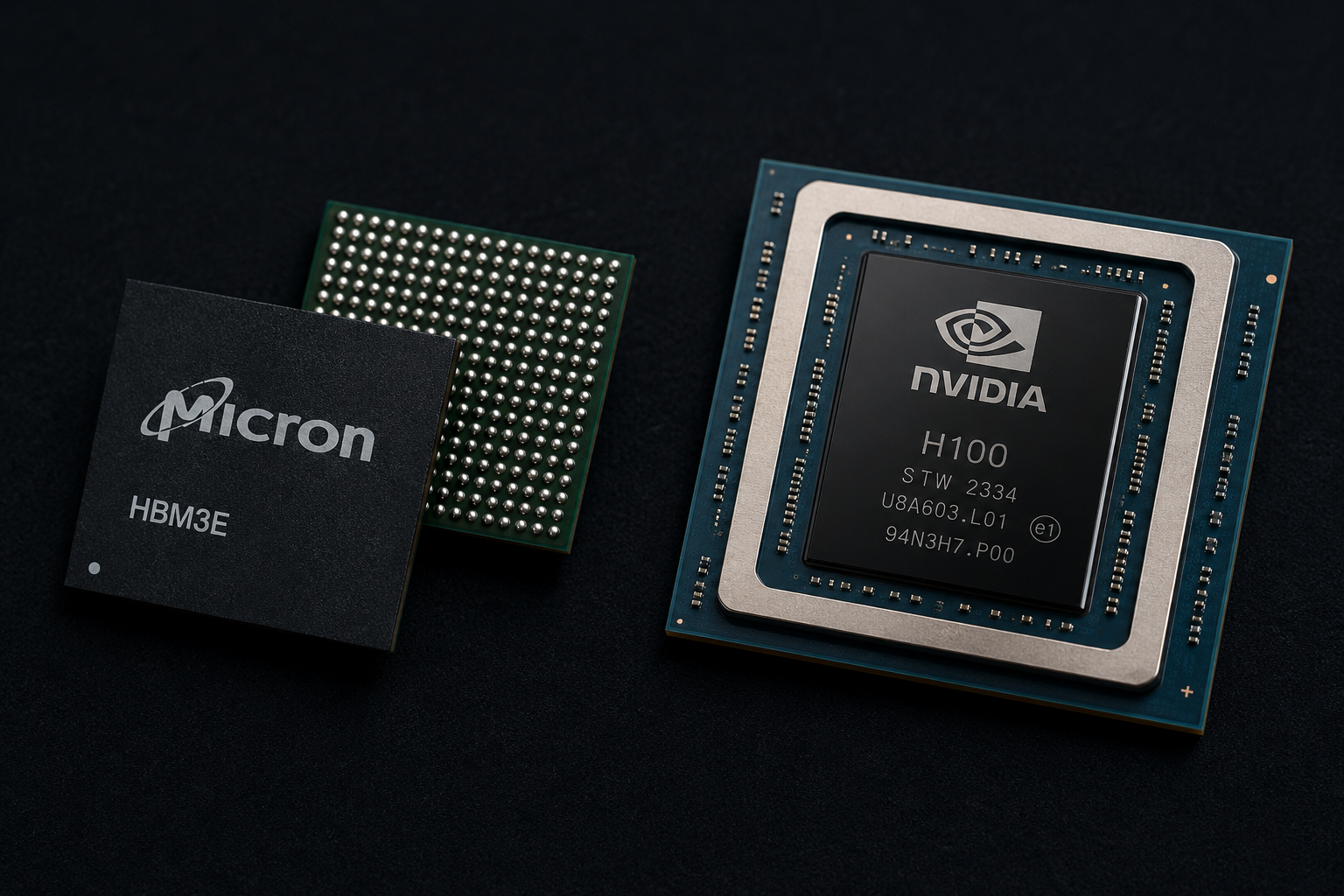
The chip that could make or break Wall Street’s confidence in artificial intelligence no longer lives inside a flashy graphics processor.
Increasingly, it sits inside a memory module, and it is made by a company that started life in a Boise, Idaho, dental office basement in 1978.
For most of its four-decade existence, Micron Technology was the kind of stock serious investors avoided.
Memory chips, dynamic random-access memory, or DRAM, and its derivatives were a commodity.
The business ran in brutal cycles: a shortage would lift prices and profits, manufacturers would race to add capacity, supply would overshoot demand, prices would collapse, and the cycle would repeat.
MU was a trade, not an investment. Wall Street treated it accordingly. That story is being rewritten at speed.
Over the past year, Micron’s shares have surged roughly 700%, with 200% of those gains arriving in 2026 alone.
Last month, the company crossed a $1 trillion market capitalisation for the first time.
Its latest quarterly earnings delivered a 346% surge in revenue and gross margins of 84.9% surpassing, remarkably, those of Nvidia.
And in a stretch when AI and technology stocks were nursing heavy losses after questions over bubble-territory valuations began circulating on Wall Street, it was Micron’s blowout results that steadied nerves and reignited confidence that the AI trade still has runway.
Two years ago, that role belonged to Nvidia.
The question investors are now asking is whether it has quietly passed the baton.
How Nvidia wrote the bellwether playbook
To understand what Micron may be becoming, it helps to understand what Nvidia became.
In November 2022, when OpenAI launched ChatGPT and set off the current AI frenzy, Nvidia’s graphics processing units, originally designed for computer games, found themselves identified as the workhorses for training AI models.
Demand exploded. Between its October 2022 low and June 2024, Nvidia’s shares surged approximately 1,100%.
By mid-2024, it had briefly become the world’s most valuable company, with a market capitalisation of $3.34 trillion, and had joined the select grouping of mega-cap technology companies known as the Magnificent Seven alongside Alphabet, Meta, and others.
But Nvidia’s significance went beyond its own price. It became a barometer.
Investors read Nvidia’s earnings reports the way they read blockbuster economic releases, not just for what they said about one company, but for what they implied about the pace and health of the entire AI buildout.
Even when Nvidia itself traded flat after reporting, its supply chain partners, Taiwan Semiconductor, SK Hynix, and ASML, would often move sharply in anticipation or in the immediate aftermath of its numbers.
“It’s not just a single stock,” Arun Sai, multi-asset portfolio manager at Pictet Asset Management, told the Financial Times last year.
“It’s very unusual for people to read through it to the economy as a whole.” That power has not vanished.
In its latest first-quarter results, Nvidia posted revenue of $81.6 billion, up 85% on the year, while net income more than tripled to $58.3 billion.
Those are not the numbers of a company in decline.
But its shares fell 1.6% in after-hours trading following the release.
The market has become accustomed to Nvidia delivering stellar figures and was pricing in something closer to perfection.
Year to date, Nvidia’s shares have risen a modest 3%.
Over the past 12 months, the gain is approximately 22%, a respectable figure for most companies, but underwhelming by the standards of what the market has come to expect.
The Nvidia era of market-moving earnings is not over; it has simply become less dramatic.
How scarcity of memory birthed the Micron of today
Micron’s rise as a new bellwether flows from a structural shift in what AI actually needs to run.
Modern AI systems require enormous amounts of data positioned directly alongside the processors crunching it.
That makes memory, specifically high-bandwidth memory, or HBM, one of the scarcest and most valuable components in an AI server.
Without enough of it, even the fastest GPU becomes a bottleneck.
As that realisation spread through 2025, Micron stopped being valued as a commodity memory producer and began being treated as a strategic supplier to the AI ecosystem.
Only three companies in the world can manufacture HBM at scale: Micron, South Korea’s Samsung, and SK Hynix.
That oligopoly, combined with the surge in AI-related demand, has produced something unfamiliar for the memory industry: sustained pricing power.
Micron’s gross margins in its latest quarter stood at 84.9%, up from 74.9% the prior period and from just 39% a year earlier.
The company expects the HBM market it serves to grow to approximately $100 billion by 2028.
Where large technology companies once faced what commentators called an “Nvidia tax”, paying a premium for indispensable chips, some now speak of a “Micron tax,” a memory toll that hyperscalers and AI infrastructure builders simply have to absorb.
Apple has been an example on that front after it had to raise the prices of its devices due to surging memory costs.
How Micron stabilised markets
The significance of Micron’s new role crystallised earlier this month.
Markets had been rattled by concerns that AI spending was outpacing any near-term revenue visibility.
SpaceX’s $25 billion bond sale, arriving so soon after its IPO, led investors to wonder if Wall Street might be entering AI bubble territory.
Ludovic Subran, chief investment officer of Germany’s Allianz, which manages €800 billion in assets, warned that markets may be shifting from “a healthy boom, a stretched boom into bubble territory.”
AI and technology stocks sold off sharply.
Then Micron reported that revenue surged 346% for the quarter.
Profit came in at $28.2 billion, almost 15 times the figure posted in the same quarter a year earlier.
The company blew past analyst expectations on every key metric, sending its stock nearly 16% higher in after-hours trading.
The results did not just lift Micron.
They stabilised the broader AI trade.
Investors took them as confirmation that the demand underpinning the entire AI infrastructure buildout, however stretched valuations may have remained real and accelerated.
A cautionary tale, and what Micron is doing about it
Nvidia’s trajectory does, however, offer a warning.
Its dominant position in AI chips, once a near-monopoly, is under pressure.
OpenAI has unveiled a custom AI chip developed with Broadcom.
Qualcomm has struck supply deals with Microsoft and Meta.
Competition is arriving from several directions simultaneously.
Micron’s shareholders would do well to hold that lesson in mind.
The more immediate risk is the one built into memory’s DNA.
Micron’s latest revenue surge was driven substantially by dramatically higher prices, margins of 85% compared to 38% a year ago, telling that story plainly.
Nvidia’s 85% revenue growth, by contrast, is not similarly dependent on elevated pricing.
As analyst David Jagielski of The Motley Fool has noted, if demand were to slow or if memory supply were to catch up with demand, Micron’s valuation, which has risen sharply over the past year, would face a steep correction.
Micron’s management is aware of the history and is attempting to break it.
The company is pursuing long-term supply contracts that lock customers in and reduce exposure to spot-market pricing swings.
CEO Sanjay Mehrotra has argued that the supply crunch is structurally different this time, as new semiconductor fabrication plants take years to build, and next-generation memory has become significantly more complex to manufacture, meaning capacity cannot be added quickly enough to produce the oversupply gluts of previous cycles.
To back that argument, Micron is investing approximately $200 billion in manufacturing and research and development, including new memory fabrication plants in Boise, Idaho, and Syracuse, New York.
Whether Micron can hold Nvidia’s former position as Wall Street’s preferred instrument for reading the AI boom will depend on whether those structural arguments prove correct.
For now, the market has decided that the most important number in AI is not measured in teraflops. It is measured in gigabytes.
The post From a dental office basement to a trillion dollars: Is Micron the next Nvidia? appeared first on Invezz
