Jimmy Carter, the centenarian former president who lived long enough to see Donald Trump elected again but died just before the start of the new year, has a foreign policy legacy that wasn’t just defined by his four years in the White House.
Over the term of his presidency, the former Georgia governor could boast of helping to establish peace between Israel and Egypt and reestablishing relations with China. But by the time he suffered one of the nation’s most decisive defeats by President Ronald Reagan in 1980, Carter still had ambitions that he was not ready to stop pursuing.
Carter is largely celebrated for the altruistic nature of his post-presidency, volunteering with Habitat for Humanity well into his 90s. He was awarded the Nobel Peace Prize in 2002 for his peace negotiations, but some accused the former president of meddling in international affairs without any official title.
Here’s a look Carter’s forays on the world stage, both as president and beyond:
Unauthorized North Korea peace treaty
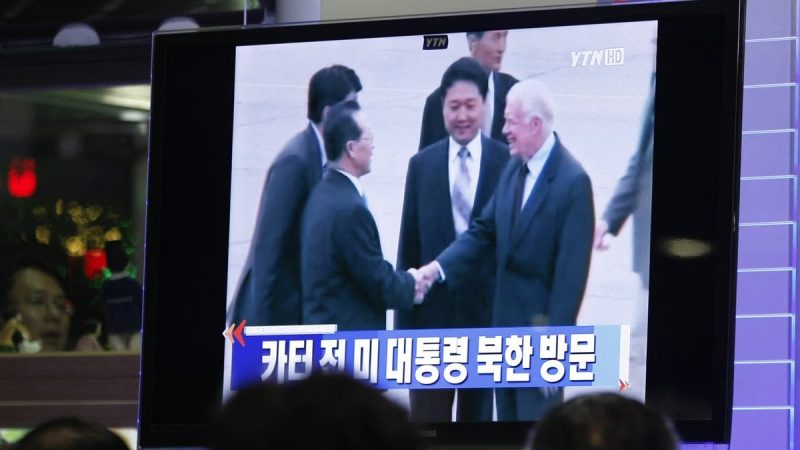
In 1994, Bill Clinton was in office in the midst of a standoff with North Korea over the communist country’s nuclear program. The U.S. was floating the idea of sanctions – and even considered a preemptive strike on North Korea’s nuclear facilities to destroy their capabilities.
Carter had received invitations from North Korea to visit, and was eager to try his hand at defusing the situation and hashing out an agreement to unify the north and the south. As Clinton weighed his options, Carter called. He had negotiated the framework of a peace agreement, without authorization.
Carter had flown to North Korea with a CNN crew and hashed out the deal. He called Clinton to warn him he was about to go on CNN to announce the deal, which infuriated the Clinton White House, according to Carter biographer Douglas Brinkley’s book, ‘The Unfinished Presidency.’
Carter also accepted a dinner invitation from Kim Il-Sung, where he stated the U.S. had stopped pursuing sanctions at the U.N., which was untrue. Backed into a corner, Clinton had to accept the peace deal and stop pursuing sanctions.
Carter’s discussions with leader Kim Il-Sung may have averted conflict with North Korea in the 1990s. The nation, of course, continued pursuing nuclear weapons and acquired them in 2006.
Carter tells Arab states to abandon US in Bush’s Gulf War
In the Middle East, Carter declared he could have resolved the conflict between the Israelis and the Palestinians in a second term, a prospect that has still not been achieved by any president.
‘Had I been elected to a second term, with the prestige and authority and influence and reputation I had in the region, we could have moved to a final solution,’ he told The New York Times in 2003.
Throughout the 1990s, Carter befriended Palestinian Liberation Organization (PLO) leader Yasser Arafat and coached him on how to appear more moderate to the west, even as Arafat continued to lead attacks on Israel and led the Second Intifada in 2000.
When President George H.W. Bush decided to launch the Persian Gulf War after Iraq’s Saddam Hussein invaded Kuwait, Carter was vehemently opposed to the idea. Five days before Bush’s deadline for Hussein to withdraw, Carter wrote to leaders of nations on the U.N. Security Council and key Arab states – Egypt, Saudi Arabia and Syria – imploring them to abandon the U.S. and its war efforts.
‘I urge you to call publicly for a delay in the use of force while Arab leaders seek a peaceful solution to the crisis. You may have to forego approval from the White House, but you will find the French, Soviets, and others fully supportive. Also, most Americans will welcome such a move.’
The move prompted former national security adviser Brent Scowcroft to accuse Carter of violating the Logan Act, which says private citizens cannot negotiate with foreign governments.
Carter meets with Hamas, angering Bush administration
In 2008, President George W. Bush’s secretary of state, Condoleezza Rice, publicly tore into Carter for meeting with Hamas, a designated terrorist group, after the administration explicitly told him not to.
Rice told reporters Carter’s meeting could confuse the message that the U.S. would not work with Hamas.
‘I just don’t want there to be any confusion,’ Rice said. ‘The United States is not going to deal with Hamas and we had certainly told President Carter that we did not think meeting with Hamas was going to help’ further a political settlement between Israel and the Palestinians.
Carter, a strong advocate of the Palestinians after his presidency, claimed that Israel’s policies amounted to an apartheid worse than South Africa’s.
Egypt-Israel peace treaty
In 1978, the groundbreaking possibility of Egypt and Israel normalizing relations had screeched to a halt. President Anwar Sadat of Egypt suggested ceasing contact with the Israelis.
In September of that year, Carter brought Sadat and Israeli Prime Minister Menachem Begin to Camp David, where Carter spent more than a week mediating negotiations on an agreement between the two sides. A framework of a treaty known as the Camp David Accords came out of that meeting, and six months later, Egypt became the first Arab state to establish relations with Israel.
The agreement included the return of the Sinai Peninsula to Egypt and a ‘pathway’ for Palestinian self-rule in Gaza. Sadat was assassinated in 1981 after Arab fury over the peace agreement.
Normalization of US-China relations
In 1978, following months of secret negotiations, Carter established formal U.S. relations with China, breaking decades of hostility between the two nations. That meant rescinding a defense treaty with Taiwan, where Carter remains a controversial figure.
It also prompted Congress to pass the Taiwan Relations Act to continue to provide arms to Taiwan and ‘maintain the capacity to resist’ any attempts to take it over.
1979 Iranian hostage crisis
In 1979, the Iranian regime’s shah, Mohammed Reza Pahlavi, and Carter had a strategic relationship, with Carter quiet on his questionable human rights record even as the shah’s grip on power was slipping.
Protests had kicked up in Iran over the shah’s oppressive policies, but Carter continued to support him, fearing the alternative: Ayatollah Ruhollah Khomeini.
Pahlavi fled into exile in January 1979, and Carter initially resisted requests to grant him refuge in the U.S. before allowing him to seek cancer treatment in New York City in October of that year. And on Nov. 4, Iranian students angry at the decision stormed the U.S. embassy in Tehran, taking 52 hostages.
The hostage crisis spanned the rest of Carter’s term and, for many, defined his legacy on the world stage. Without any resolution, in April 1980, Carter moved to a military rescue.
The mission ended in tragic failure: several helicopters were grounded outside Tehran in a sandstorm, and eight special forces members were killed when their helicopter crashed. Iran then captured U.S. equipment and intelligence.
The hostages were not released until Jan. 20, 1981 – minutes after President Ronald Reagan was inaugurated.
Signing Panama Canal back to Panama
President-elect Trump has brought Carter’s Panama Canal treaties back into the spotlight, musing on Tuesday that offering control of the canal to Panama lost Carter the 1980 election.
Despite fierce opposition from the right, Carter believed returning the canal would improve U.S. relations in Latin America and ensure peace between U.S. shipping lanes, fearing that opposition to U.S. control could lead to violence on the waterway.
‘It’s obvious that we cheated the Panamanians out of their canal,’ Carter wrote in a diary. But he’d also received intelligence that it could take up 100,000 troops to defend the canal in the event of an uprising.
In recent days, Trump has suggested taking the canal back – claiming the U.S. is paying too much to use it, and it is controlled by China.
‘Giving the Panama Canal to Panama was a big reason why Jimmy Carter lost the election, even more so than the hostages,’ Trump said.
