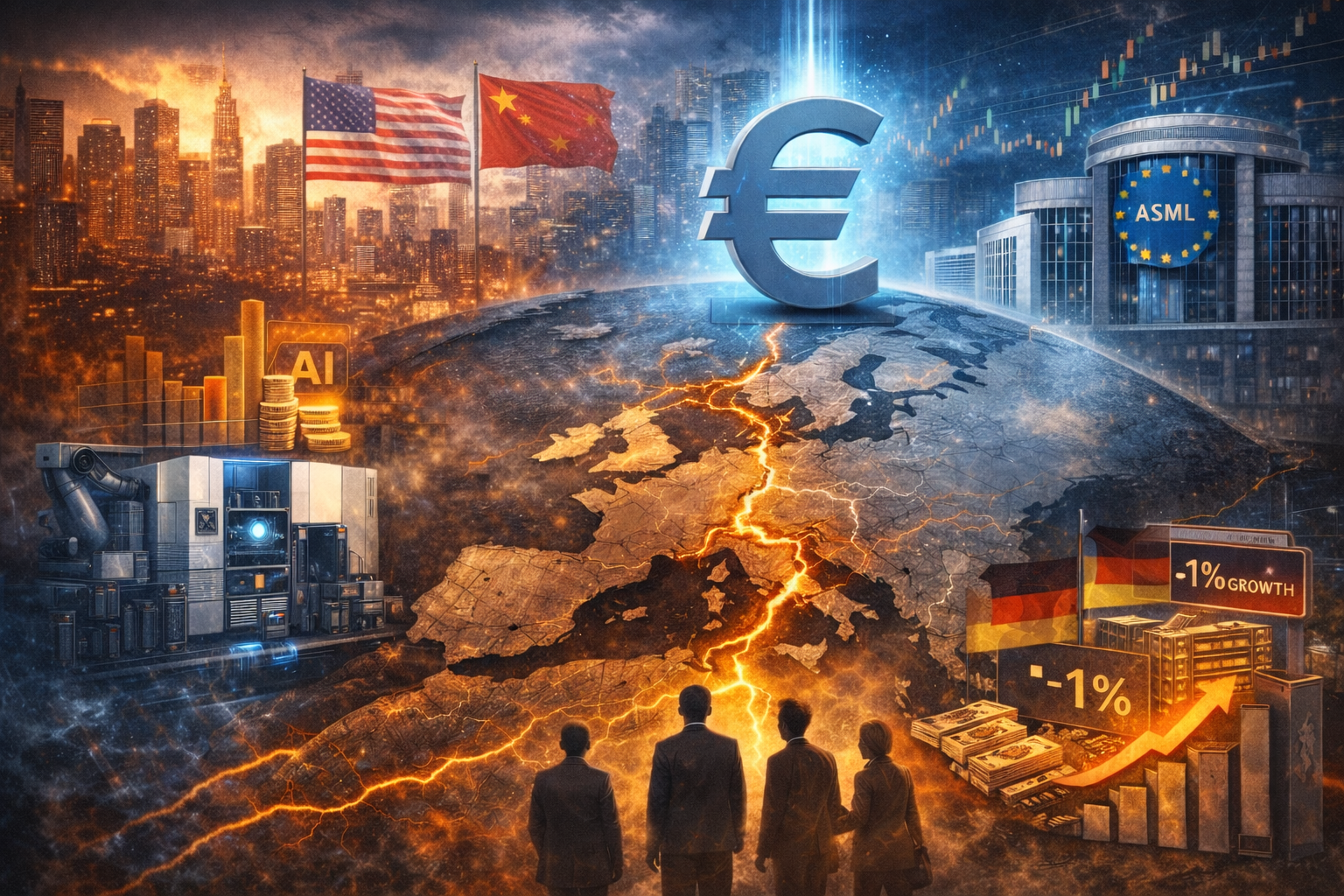
Europe’s fault lines are widening as leaders, markets, and central banks grapple with a more hostile global order.
From Keir Starmer’s delicate China outreach under Washington’s glare to Germany’s faltering growth despite massive spending promises, the continent’s economic engine is sputtering.
Corporate bright spots like ASML’s AI-fueled boom contrast sharply with policy anxiety, as a surging euro rattles ECB hawks and exposes Europe’s vulnerability to geopolitics, trade shocks, and structural decay.
Britain’s Starmer walks tightrope between Trump and Xi
Prime Minister Keir Starmer touched down in Beijing on Wednesday, the first British leader there since 2018, bringing 50 business chiefs to reset fractured ties with China.
The pragmatic gambit: unlock economic opportunities from the world’s second-largest economy while reassuring Washington he won’t abandon the alliance.
But the timing screams desperation. With Trump threatening 100% tariffs on allies and fracturing Western unity, Western leaders are quietly de-risking from America, using Beijing as insurance.
Starmer insists the UK can deepen China trade without angering Trump, but critics, both British and American, say he’s underestimating security threats and capitulating to Beijing’s pressure.
ASML crushes expectations with record Q4
Dutch semiconductor equipment giant ASML delivered a blockbuster quarter on Wednesday, posting record €9.7 billion in Q4 revenue while full-year sales hit €32.7 billion, 16% growth that sent shockwaves through AI-obsessed markets.
But the real story: €13.2 billion in record quarterly bookings, crushing analyst expectations of €6.3 billion.
EUV systems, the holy grail of advanced chipmaking, accounted for €7.4 billion of that order surge.
Management lifted 2026 guidance to €34–39 billion, signaling confidence AI demand isn’t a flash. Backlog ballooned to €38.8 billion.
The catch? ASML flags tight supply constraints ahead, geopolitical China exposure, and massive capex requirements to scale.
For investors watching semiconductor spending, this is the clearest signal yet that the AI capex cycle has real staying power.
Germany cuts growth forecast to 1%
Berlin lowered its growth forecast Wednesday to a tepid 1% for 2026, down from October’s 1.3%, admitting government spending isn’t translating to the economy fast enough.
The culprit: bureaucratic sluggishness. Of the €500 billion infrastructure fund approved in March, only €24 billion was deployed by year-end.
Growth for 2027 trimmed to 1.3% from 1.4%. The brutal truth: Europe’s largest economy is stuck in structural decline. Manufacturing has eroded 7% since 2017.
Chinese competition is gutting export markets.
Trump’s tariffs could shave 0.6 percentage points off growth. Even with splurging €500+ billion on defense and infrastructure, Germany can’t outrun deflationary pressures from an aging workforce and productivity collapse.
Without painful labor market reforms and digitalization overhaul, Berlin’s fiscal splurge is just an expensive band-aid on a broken economy.
ECB hawks awaken as euro hits 1.20 against dollar
The European Central Bank’s policymakers broke silence Wednesday, flagging deep unease over the euro’s surge to 1.20 against the dollar, the strongest since 2021, warning it threatens to push inflation below their 2% target.
Bank of France Governor François Villeroy de Galhau declared euro appreciation “a factor that will guide our monetary policy in the months ahead.”
Austrian central banker Martin Kocher went blunter: further euro gains could force another rate cut.
The culprit: Trump’s indifference to dollar weakness, combined with global flight-to-safety flows into euros.
The ECB’s quandary is real: a stronger euro theoretically reduces import costs and inflation, exactly what they want.
But if it overshoots, it undercuts their entire policy framework and cripples eurozone exporters already gasping against Chinese competition.
The post Europe bulletin: Starmer courts China, ASML surges on AI, Germany’s growth stalls appeared first on Invezz
