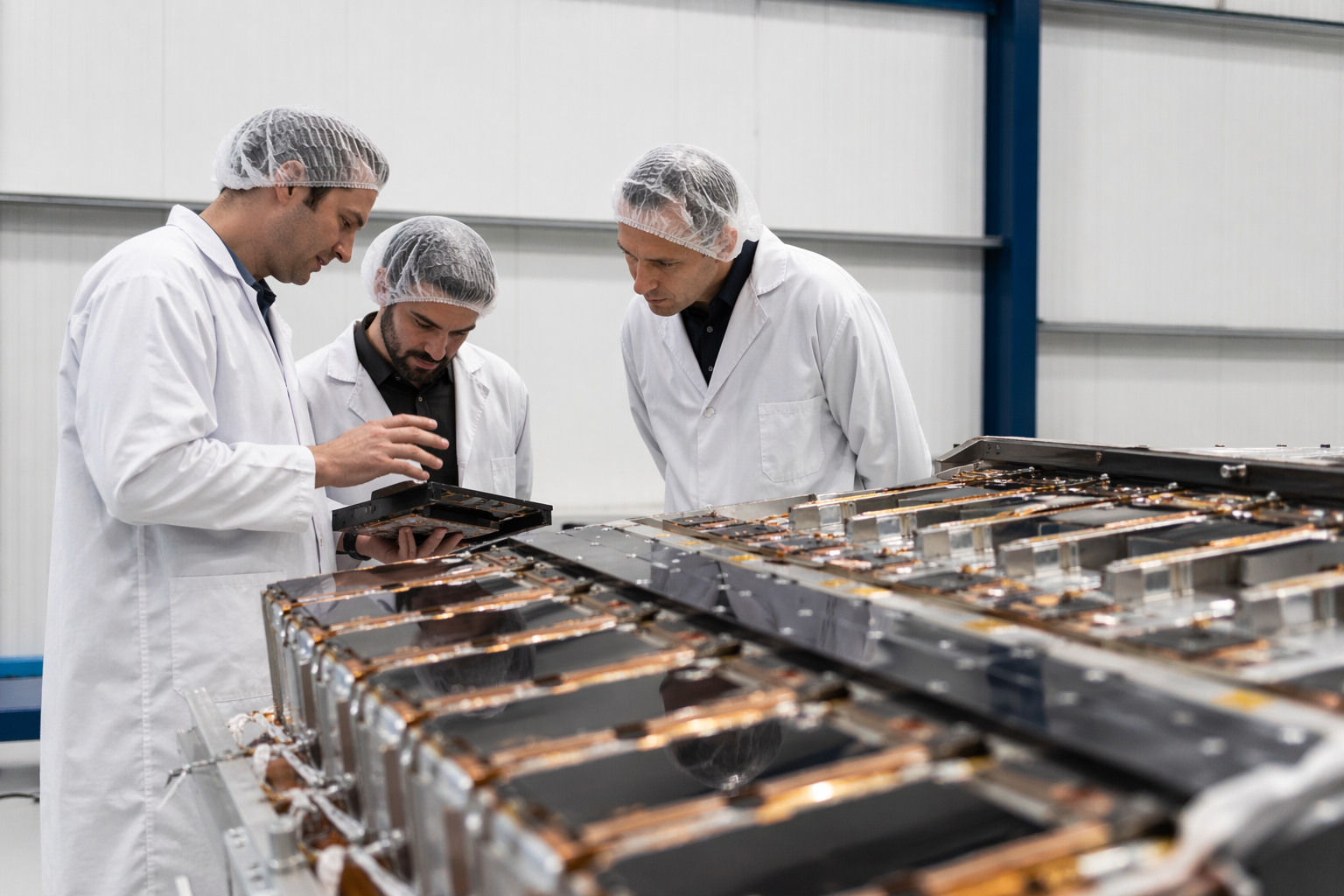
Univity, a satellite internet startup backed by the French state, said on Thursday it had closed a €27 million ($32 million) funding round.
The company aims to launch thousands of satellites and position itself as Europe’s largest satellite operator.
The Series A funding round, combined with a €31 million contract from the French space agency, brings Univity’s total secured funding to €68 million.
CEO Charles Delfieux confirmed the figures, noting that the investment marks a key milestone for the company’s expansion plans.
French state-owned investment bank Bpifrance participated in the round, alongside investment platform Blast and venture capital fund Expansion.
France pushes for reduced reliance on US providers
The funding comes as France leads broader European efforts to reduce dependence on US-based satellite internet services.
Unlike competitors such as Elon Musk’s Starlink or Amazon, which focus on direct-to-consumer services, Univity is targeting telecom operators.
The company plans to share infrastructure and offer space-based internet and mobile services to these operators.
Delfieux told Reuters that Univity has already signed 16 agreements with telecom operators across four continents.
The partnerships underline growing demand among telecom firms seeking to integrate satellite connectivity into their networks.
Plans to build large VLEO satellite constellation
Founded in 2022, Univity is planning to build a fleet of up to 3,400 satellites in very low Earth orbit (VLEO), roughly 375 km above Earth.
This would make it Europe’s largest satellite operator if achieved.
For comparison, Starlink currently has around 10,000 satellites in orbit, while Amazon’s low Earth orbit project plans to deploy roughly 7,000 satellites.
The push reflects a broader trend where telecom operators globally are signing deals with satellite providers to extend coverage in remote areas.
Such partnerships help bridge connectivity gaps where upgrading terrestrial infrastructure would be more costly.
Focus on cost efficiency and production strategy
Delfieux highlighted the competitive dynamics shaping the sector.
“In this new era of satellite communication pushed by Starlink and Amazon, mass production and recurrent prices have become the battle(field),” Delfieux said, as quoted by Reuters.
He added, “One way to provide highly competitive services to our clients is to internalize production.”
The company plans to manufacture its satellites near Toulouse to manage costs more effectively.
Roadmap for deployment and future funding
Univity said its current funding will support the launch of its first two satellites.
The company then plans to transition to an infrastructure financing model for large-scale deployment from 2028.
This next phase is expected to involve “deep-pocketed investors” such as infrastructure funds and telecom operators, Delfieux said.
The strategy signals a shift from early-stage funding to long-term capital deployment, aligning with the company’s ambition to scale its satellite network significantly in the coming years.
The post Univity raises €27M to build Europe’s biggest satellite network appeared first on Invezz
