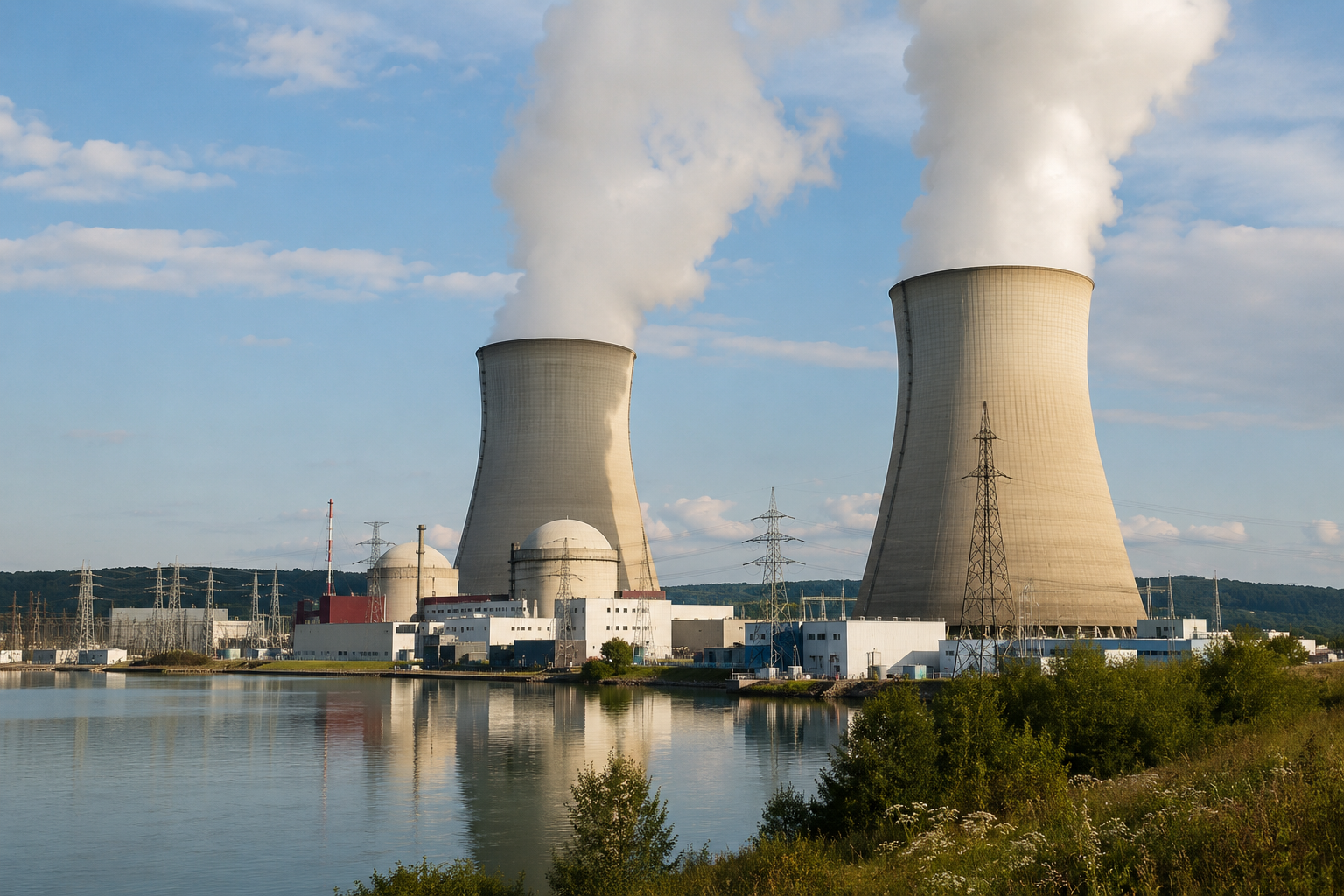
Nuclear energy is emerging as a long-term investment theme as artificial intelligence-driven electricity demand accelerates global power needs.
While nuclear projects typically take years or even decades to develop due to regulatory and construction timelines, analysts argue that this structural friction also creates durable competitive advantages for established operators and developers.
Several companies across the nuclear value chain are increasingly being positioned to benefit from long-term contracts with technology firms seeking reliable, carbon-free baseload power.
Constellation Energy
Constellation Energy is the largest nuclear fleet operator in the United States and has recently expanded its role through long-term agreements with major technology companies.
The company signed a 20-year power purchase agreement (PPA) with Microsoft in 2024 to restart the Three Mile Island facility, now rebranded as the Crane Clean Energy Center, delivering more than 800 megawatts of carbon-free power to Microsoft’s data centers in the PJM region.
The deal has been described as a template for long-term nuclear supply agreements with hyperscalers.
Since then, Constellation has also signed a 20-year PPA with Meta Platforms, extended operating licenses across its Illinois fleet through 2047 and beyond, and completed its $26.6 billion acquisition of Calpine, making it the largest power producer in the United States.
Three Mile Island is expected to return to service in 2027.
The company also recently advanced regulatory progress on its restart plans, with federal waivers supporting earlier-than-expected approvals.
TipRanks data shows that 16 out of 18 analysts have a buy rating for CEG stock with an average price target of $369.56, indicating a 34% upside.
Cameco
Cameco is positioned as a key supplier in the nuclear fuel cycle, focusing on uranium production and reactor technology exposure through its stake in Westinghouse Electric.
The company holds more than 433 million pounds of proven and probable uranium reserves and owns a 49% stake in Westinghouse, which provides reactor services globally and manufactures the AP1000 reactor design.
The AP1000 is currently being deployed in countries including Poland and Bulgaria.
Westinghouse has also advanced plans for its AP300 small modular reactor, intended for industrial sites, remote communities, and defense applications.
In 2025, Cameco and Brookfield signed a binding term sheet with the US Department of Commerce to accelerate global reactor deployment through Westinghouse, with an aggregate investment value of at least $80 billion.
The US government is now described as an active partner in scaling production.
9 in 11 analysts had a buy rating for CCJ stock, with a $127.04 average price target. This indicates a 19% upside.
Vistra
Vistra operates a diversified energy portfolio and is building long-term agreements tied to nuclear generation, particularly in the PJM region.
In January 2026, Vistra and Meta Platforms announced 20-year PPAs supporting three nuclear plants while also expanding new nuclear capacity.
The company operates a mix of nuclear, natural gas, and energy storage assets and is increasing its zero-carbon generation portfolio.
Vistra’s investment case is centered on the growing value of firm, dispatchable, carbon-free power, particularly as AI-related infrastructure increases electricity demand.
The company’s strategy focuses on scaling existing nuclear assets rather than pursuing large transformational acquisitions.
All 13 analysts in TipRanks’ coverage gave VST stock a buy rating with a target price of $225.25, a 37% upside.
Oklo
Oklo represents a higher-risk, early-stage nuclear developer focused on small modular reactors and recycled fuel technology.
Its Aurora powerhouse, designed to run on recycled nuclear fuel, broke ground at the Idaho National Laboratory in September 2025.
In March 2026, the company received Preliminary Documented Safety Analysis approval from the US Department of Energy, a key regulatory milestone.
In January 2026, Meta signed an agreement with Oklo to develop a 1.2 gigawatt nuclear campus in Pike County, Ohio, with upfront funding provided to support early development. The project is intended to be anchored by Meta’s long-term electricity demand.
Oklo has also signed agreements across multiple data center operators, including a 12 gigawatt master power agreement with Switch, along with pre-agreements with Equinix and Prometheus Hyperscale. The company reports a total order book exceeding 14 gigawatts.
Oklo’s model includes owning and operating its plants, linking revenue growth directly to deployment scale.
9 out of 15 analysts gave OKLO stock a buy rating, indicating a 53% upside at a price target of $93.92.
Nano Nuclear Energy
Nano Nuclear Energy is also drawing analyst attention as interest in micro-modular reactors increases amid rising AI-driven electricity demand.
Roth Capital Partners initiated coverage on NNE stock with a buy rating and a $45 price target, implying about 60% upside. Analyst Craig Irwin highlighted progress on the company’s KRONOS micro-modular reactor.
“Management is making rapid progress toward commercializing its 15 MWe KRONOS micro-modular-reactor (MMR), while diversifying operations across the uranium lifecycle,” the analyst said in a report to clients. “The opportunity for SMR reactors will likely be very large … and demand is accelerating. Potential advance orders from hyperscalers are an obvious catalyst.”
The analyst also noted rising global electricity demand, which increased by 849 Terawatt-hours in 2025 according to the International Energy Agency.
Nano Nuclear has gained momentum in recent months, supported by expectations of increased energy demand from AI applications.
The post Nuclear stocks to own as AI demand drives power boom appeared first on Invezz
