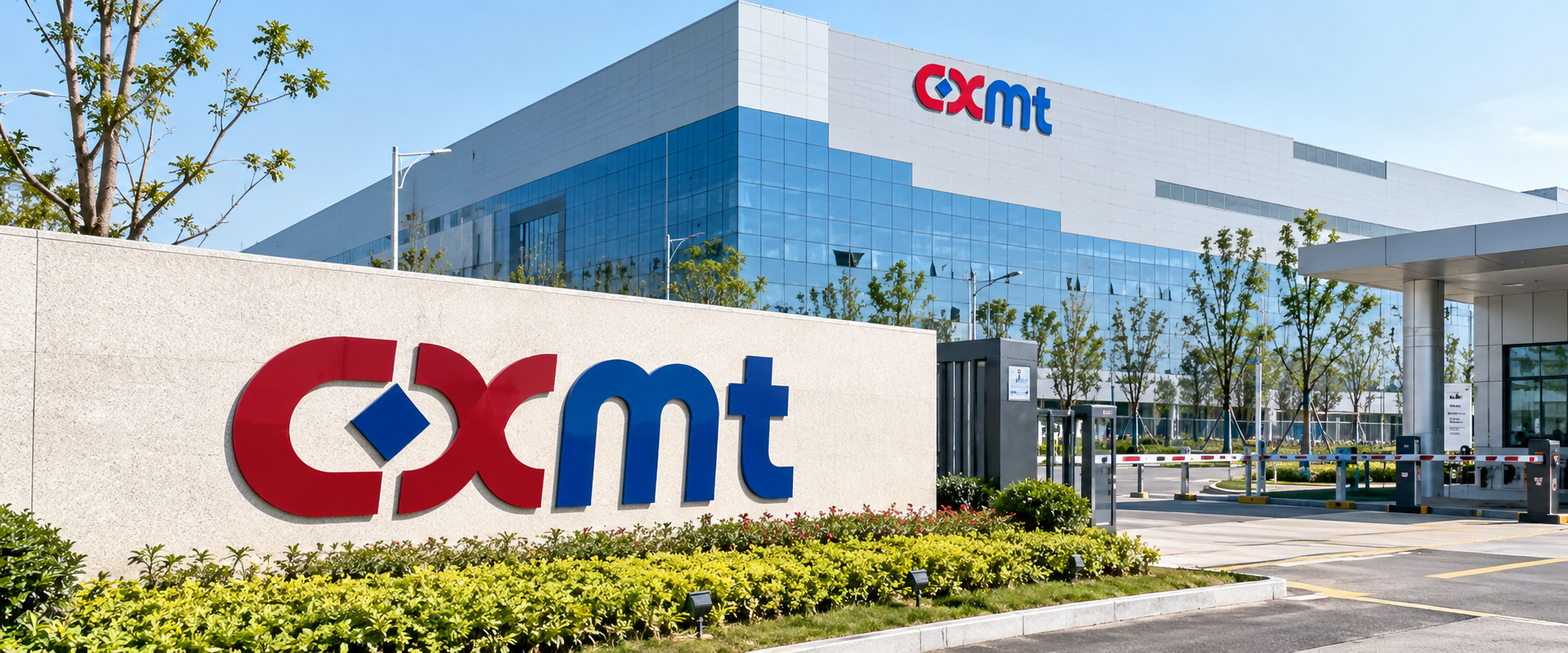
Memory chip stocks, including Micron Technology, Samsung Electronics and SK Hynix, have been battered several times this year by reports of technological advances at China’s ChangXin Memory Technologies (CXMT).
Investors fear the Chinese chipmaker could eventually erode the competitive advantage enjoyed by the industry’s leading players, whose shares have soared amid the artificial intelligence boom.
The logic is straightforward.
Memory chipmakers have benefited from surging demand driven by AI, a small number of major suppliers and their inability to expand production quickly enough to meet that demand.
The resulting supply constraints have supported prices and boosted earnings expectations.
If CXMT can expand production and close the technological gap with its global competitors, investors fear that additional supply could put downward pressure on memory prices and unwind some of the gains made by the memory chip trade.
The latest trigger came when CXMT President Cao Kanyu told an industry conference that the company had made a key advance in a next-generation memory cell architecture known as 4F-squared.
The technology could allow more memory cells to fit on a chip of the same size than the existing 6F-squared structure.
He said the company planned to introduce a new server-memory product based on the technology by the end of 2026, according to a company statement.
The announcement sent shares of Samsung, SK Hynix and Micron MU sharply lower on Monday and Tuesday, while also weighing on other technology stocks and markets around the world.
Morningstar equity analyst Jing Jie Yu said CXMT’s announcement had disrupted investor expectations around technology development timelines and heightened concerns about the accelerating pace of lower-cost Chinese technologies that could disrupt leading AI firms.
“If the company can commercialize this technology ahead of its peers, it speaks volumes to China’s DRAM technological competitiveness and raises risks of oversupply longer term given the country’s rapid expansion in DRAM capacity,” he said.
What is 4F-squared technology?
Most memory chips today use a 6F-squared structure, with the terminology referring to the amount of space occupied by each memory cell.
A smaller structure can allow cells to be packed more tightly, increasing the amount of data that can be stored on a chip.
The 4F-squared, or “4F square”, architecture is a new chip-design approach intended to improve storage density by fitting more cells into the same area.
Samsung and SK Hynix are also pursuing 4F-squared designs as an upgrade to the widely used 6F-squared structure.
The concern for investors is that CXMT could introduce the technology sooner than expected.
CXMT has already established itself as a significant player in the global memory industry.
The company staged a blockbuster initial public offering on Shanghai’s Star market in July, briefly becoming China’s most valuable company. It is now the world’s fourth-largest DRAM chipmaker.
A Counterpoint Research report published last month showed that CXMT captured 10% of the global DRAM market in the second quarter of 2026, compared with 4% in the same period a year earlier and 8% in the first quarter.
Samsung held a 38% share of the market, followed by SK Hynix at 25% and Micron at 24%.
CXMT has given memory investors more reasons to worry
Despite its rapid growth, CXMT faces significant obstacles in expanding its technological capabilities.
US export controls have restricted China’s access to advanced chipmaking equipment, including ASML’s extreme ultraviolet (EUV) lithography machines, which are considered essential for manufacturing the most advanced semiconductors efficiently.
Nevertheless, developments over recent months have raised concerns that the company could become a more formidable competitor.
In August, reports emerged that Apple had been testing CXMT memory chips across product lines, including iPhones and MacBooks, as it sought to address the memory crunch affecting the industry.
“While US government is unlikely to allow made in China memory sales to US, sales to data centers in other regions like Europe could indirectly impact Micron,” Citi analysts said in a note from August.
CXMT was also reported to be considering the construction of a second memory-chip fabrication plant in Beijing as it sought to expand production during a global semiconductor shortage fuelled by artificial intelligence spending.
Its progress in manufacturing technology has added to investor concerns.
Last month, CXMT moved its latest DRAM technology into mass production.
The company said its fifth-generation process could produce at least 50% more dies per wafer than its previous platform, while improving power efficiency and manufacturing economics.
The developments suggest CXMT is making progress in narrowing the technological gap with established memory suppliers.
Why analysts are not sounding the alarm yet
However, analysts remain cautious about treating it as an immediate competitive threat, citing its manufacturing limitations and the difficulty of producing advanced chips at scale.
“First, announcing a new memory architecture and successfully manufacturing it at scale are two completely different things,” Milk Road analyst Melvin said on X, adding that CXMT still needs to prove it can deliver competitive yields, pricing, reliability, and production volumes.
“Second, we’re currently dealing with an enormous memory supply shortage, particularly as hyperscalers continue increasing AI infrastructure spending. Even if CXMT successfully doubles its capacity, that doesn’t automatically mean the industry becomes oversupplied. Demand for memory is expected to grow substantially over the next several years, and we’re already seeing manufacturers secure longer term supply agreements with customers,” he said.
They have also argued that CXMT’s progress does not necessarily mean its South Korean rivals are falling behind.
Memory manufacturers still have other ways to improve productivity per wafer without changing the underlying cell structure.
“Korean companies have some easy methods they can use, and once those are exhausted, they’ll have to start tackling the more difficult ones. But with CXMT, the US has imposed restrictions preventing the sale of equipment, so there are no easy solutions,” CW Chung, a senior analyst at Nomura based in Hong Kong, said in a Nikkei Asia report.
“Since there’s no easy solution, the company is now resorting to stopgap measures, either multi-patterning or trying to adopt this 4F-squared technology a bit sooner.”
Mizuho says CXMT’s latest announcement changes little
Mizuho TMT specialist Jordan Klein said the latest announcement did not change the investment case for Micron, SanDisk, SK Hynix or Samsung Electronics.
“I would not be selling or in a panic if I owned MU, SNDK, SKHY or Samsung over comments yesterday by CXMT sr mgmt. about their new advanced DDR5 design roadmap. To me this changed nothing near term. Something to watch and monitor closely, but that is about it,” Klein wrote in a note to clients.
Klein outlined seven reasons why the announcement fell short of establishing an immediate competitive threat.
One of the key issues was the difference between CXMT’s stated product introduction timeline and the reported mass-production target of its rivals.
Samsung’s reported target for mass production of comparable 4F-squared DRAM technology is 2028, while CXMT has indicated that it intends to introduce a product by the end of 2026.
Klein argued that the two milestones could not be compared directly.
“A year-end product introduction can’t be directly compared with Samsung’s reported 2028 mass-production target. A launch doesn’t establish manufacturing maturity, yields, or cost competitiveness,” he wrote.
He was also sceptical that the announcement pointed to an imminent glut of memory chips, one of the main concerns behind the recent sell-off.
“CXMT hasn’t shown mass-production success or verified yields and performance for its 4F² products, so it’s premature to assume an imminent supply glut,” he noted.
CXMT has not released complete specifications, verified yields, customer qualification results or commercial-scale shipment commitments for its 4F-squared server registered dual in-line memory module (RDIMM).
Klein also cautioned against assuming that a smaller memory-cell structure would automatically translate into cheaper chips.
Process complexity, manufacturing yields and integration requirements all influence the final cost, and CXMT has yet to demonstrate that it can match its rivals on those measures.
Conventional DRAM is not the same as AI-focused HBM
Lastly, experts say the latest announcement is primarily focused on conventional DDR5 server memory, and not HBM.
“That’s an important distinction because HBM is becoming one of the most valuable parts of the memory industry, with Micron, Samsung, and SK Hynix benefiting from enormous AI demand,” said Melvin.
HBM is the stacked memory architecture central to AI accelerator systems built around graphics processing units and application-specific integrated circuits.
HBM has become particularly important as AI infrastructure spending increases demand for advanced memory used alongside powerful processors.
The ability to manufacture conventional DRAM does not, by itself, establish that a company can compete at the same level in HBM.
Klein also noted that CXMT is not alone in pursuing 4F-squared technology.
Samsung and SK Hynix are working on similar DDR5 designs, making the architecture part of a broader industry transition rather than an advance exclusive to China.
Still, he cautioned investors against dismissing the long-term competitive threat posed by Chinese memory makers.
“You do not want to dismiss CXMT or their NAND peer YMTC. And I am not doing that,” he wrote.
Melvin agreed, saying increased Chinese manufacturing capacity is “absolutely something investors should monitor”, especially over the longer term; however, adding that right now, investors are confusing a legitimate long-term competitive threat with an immediate change in industry fundamentals.
“Nothing about today’s announcement suddenly creates millions of additional memory chips, eliminates existing supply shortages, or changes the amount of memory needed to power AI infrastructure,” he said.
The post Do Micron, Samsung, SK Hynix stocks really face a threat from CXMT? Analysts answer appeared first on Invezz
