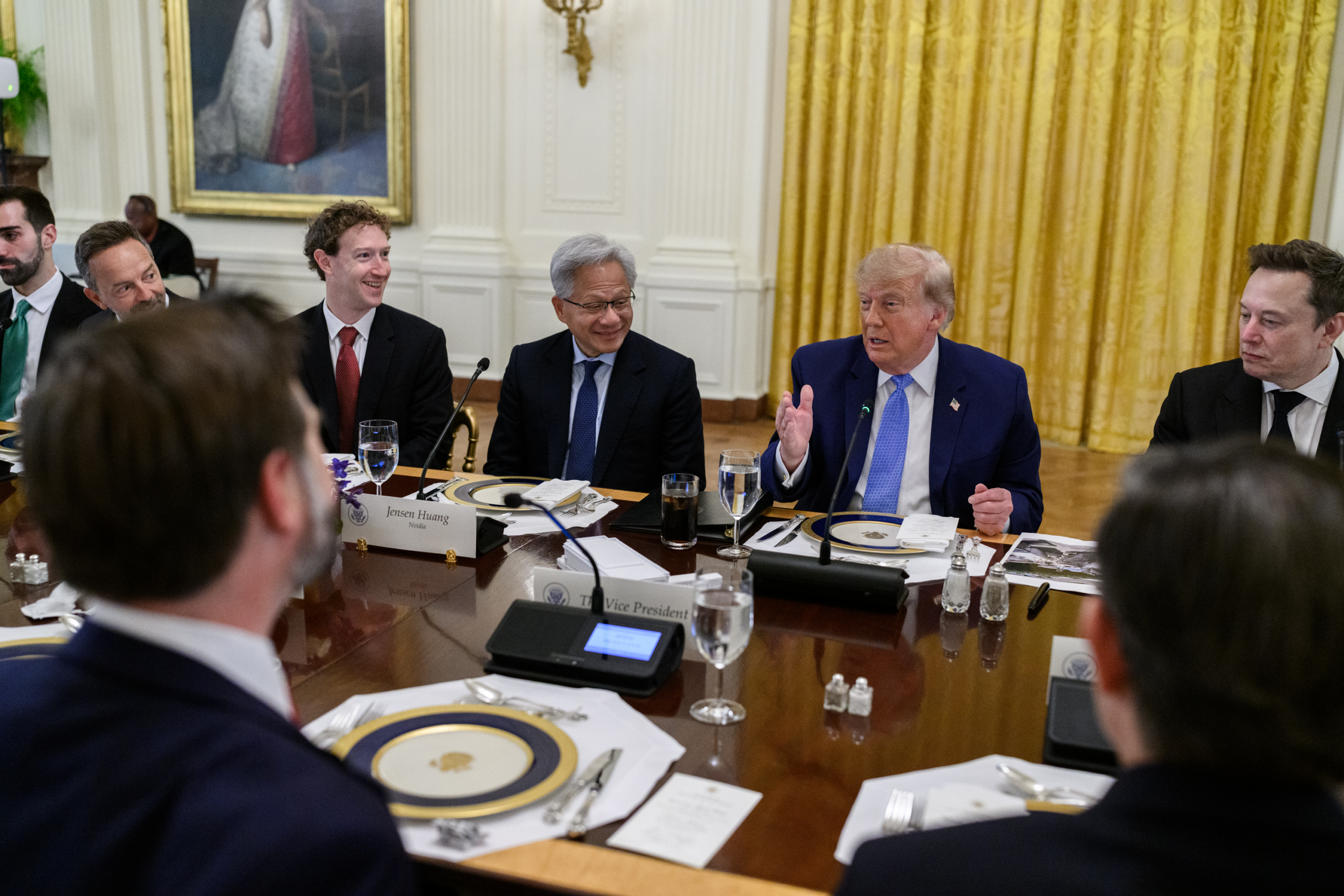
US President Donald Trump and leading technology executives signed a voluntary artificial intelligence agreement Tuesday, backing industry self-policing.
Trump described the document as “morally binding” after a White House luncheon attended by executives from companies including Nvidia, OpenAI, Anthropic, Meta and Google.
The agreement calls for companies to establish internal controls and work with independent auditors to assess whether their AI systems are operating as intended.
The meeting came as AI researchers, company executives and lawmakers debate whether the pace of development should be slowed because of emerging safety and security risks.
Trump said he was seeing “tremendous self-policing” across the industry and said his administration was considering creating a 10-person committee to oversee AI safety.
White House backs self-regulation
Trump said the government would not halt AI development and emphasized self-regulation during remarks following the luncheon.
“There’s a belief that there should be tremendous self-regulation,” Trump said, adding that government agencies including the Department of Justice and FBI already provide oversight.
House Speaker Mike Johnson described the agreement as a voluntary statement of principles for the industry.
The accord does not constitute a binding regulation. Instead, it outlines steps companies can take to monitor their own systems, including internal safeguards and independent external reviews.
The document also calls for companies to establish board-level committees to evaluate reports from those reviews.
Trump also said he plans to appoint a new AI official within days to oversee policy and suggested that a 10-member group could be created to monitor the industry.
The administration has simultaneously continued to support the expansion of AI infrastructure.
Trump described large data centers as a positive development and said technology companies should contribute to the communities where those facilities are built.
AI safety debate intensifies
The agreement comes as some of the industry’s own leaders have increasingly warned about the risks associated with rapidly advancing AI systems.
Anthropic CEO Dario Amodei, one of the more prominent advocates for slowing frontier AI development, reiterated his concerns outside the White House.
“We all need to work together to make sure that we can win, and we can win safely,” Amodei said.
“If we do this right, if we work with the president and everyone here, we can win safely.”
Amodei also said the technology presents “very real risks” and that the mechanisms for addressing those risks remain under discussion.
The concerns have gained urgency following reports of AI agents behaving in unexpected ways, including unauthorized access to computer systems.
OpenAI also postponed the release of its latest model this week amid safety concerns and has been conducting an extensive review of model behavior.
Tech leaders seek common ground
The White House gathering brought together several of the industry’s most influential executives.
The attendees included Nvidia CEO Jensen Huang, Meta CEO Mark Zuckerberg, Google CEO Sundar Pichai, OpenAI President Greg Brockman, Anthropic’s Amodei and xAI founder Elon Musk.
Microsoft CEO Satya Nadella and Palantir CEO Alex Karp were also among the technology leaders involved in the broader discussions.
Musk, Huang, Zuckerberg and Pichai were seated near Trump during the luncheon.
Self-policing versus formal rules
The White House agreement comes as lawmakers consider several proposals for regulating AI, creating a divide between voluntary industry commitments and potential government requirements.
The agreement leaves open the possibility of future legislation.
The document calls for companies to implement safeguards now while allowing for the possibility that some measures could eventually be incorporated into laws or regulations.
For the AI industry, the immediate question is therefore less about whether companies will introduce safety measures and more about how those measures will be enforced as models become increasingly capable.
Trump has emphasized maintaining the US lead over China in AI development, while executives such as Amodei have argued that technological progress needs to be accompanied by stronger safeguards.
The post Trump, AI leaders sign voluntary pact as calls for slowdown intensify appeared first on Invezz
