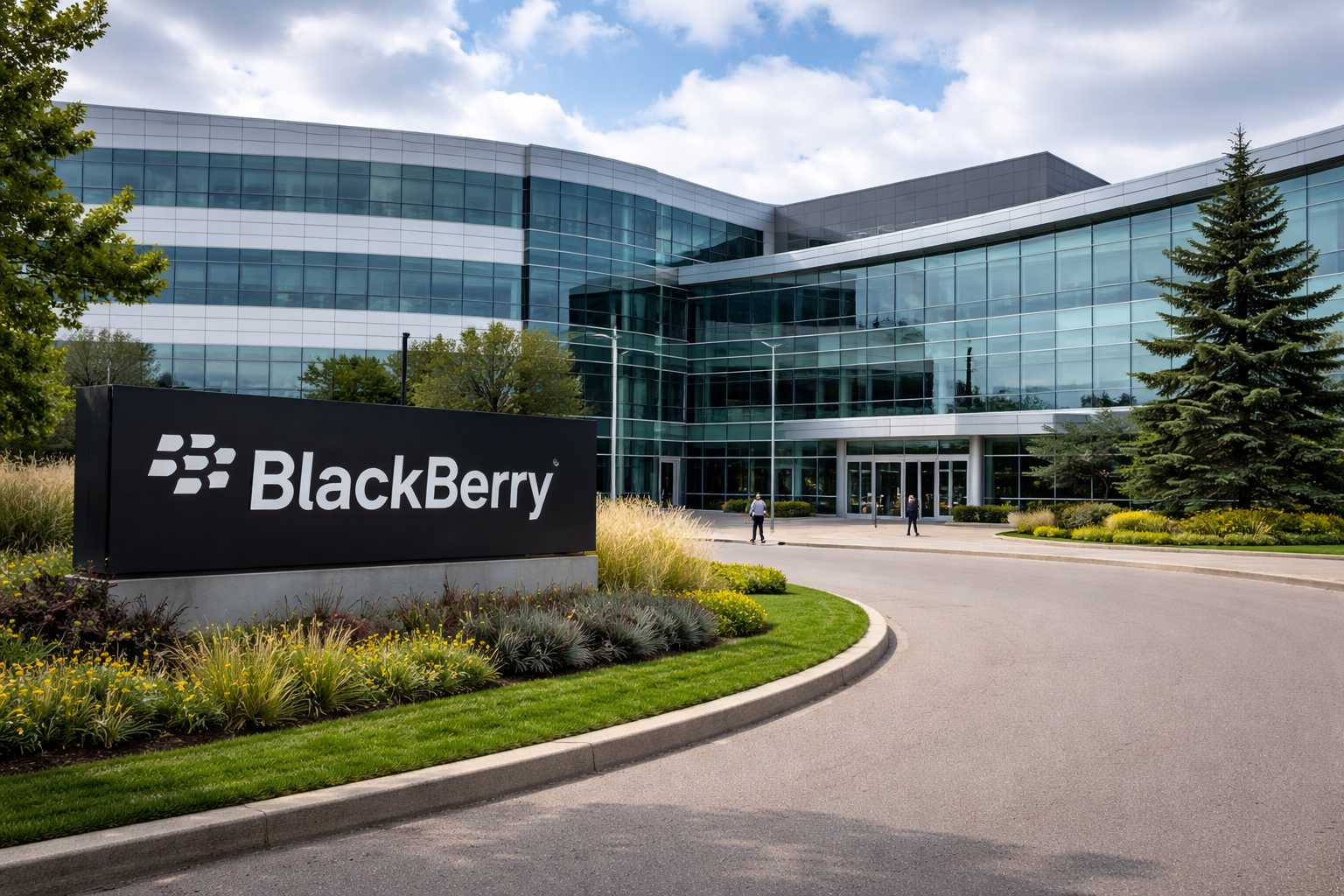
BlackBerry Ltd (BB) has undergone a massive fundamental transformation, culminating in its Q1 earnings beat on June 24th.
Driven by a 26% year-on-year increase in the QNX software division and the first positive operating cash flow in nine years, BB shares hit a new 52-week high of $12.15 on Monday morning.
However, following a nearly 300% pop since late March, the risk profile for BlackBerry stock has shifted significantly.
Here are the three key risks it faces in the back half of 2026.
Technicals warrant taking profit in BlackBerry stock
While Morningstar and other Wall Street firms have recently revised estimates for BlackBerry Ltd to reflect long-term QNX trajectory, the stock is currently trading at a stretched valuation.
The company’s recently posted quarterly release confirms it’s well-positioned to ride the artificial intelligence (AI) tailwinds, but its current 88x forward earnings multiple makes it infinitely more expensive to own than the best-of-breed AI stocks, even including Nvidia.
Plus, BB stock’s relative strength index (RSI) currently sits in the late 70s – reinforcing that it’s severely “overbought” at current levels.
This means any microscopic hiccup in execution or future guidance miss will likely trigger heavy profit-taking, especially since BlackBerry does not pay a healthy dividend either.
Concentration risk could hurt BB shares
Investors are recommended to exercise caution in playing BlackBerry shares at current levels also because the investment thesis is rapidly morphing into a pure-play bet on “Physical AI”, robotics and software-defined vehicles (SDVs) via its QNX division.
While the revenue from that segment jumped 26% on a year-over-year basis in BB’s latest reported quarter, management’s overall full-year 2027 outlook remained at a relatively modest $621 million tops.
Therefore, if macro headwinds or supply chain bottlenecks stall global automotive production or slow down industrial automation rollouts, BlackBerry’s growth engine could cool down quickly.
Yes, its smaller secure communications and cybersecurity unit has scored a high-profile contract with the Canadian government, but the business itself remains a lower-growth asset.
The enterprise cybersecurity sector is fiercely competitive, dominated by notable names like Palo Alto Networks and CrowdStrike.
For BB, the challenge is defending its turf in regulated industries – like government and defense – without letting this division become a drag on the broader company’s margins.
Wall Street warns of significant downside in BlackBerry
All in all, BlackBerry has demonstrated beyond doubt that it can execute a turnaround, but at north of $12, investors are paying a huge premium for its role in the future of automotive software and robotics.
The line between its fundamental value and its current “AI play” hype is rather thin – something that isn’t really lost on Wall Street analysts either.
According to The Wall Street Journal, the consensus rating on BB shares sits at “Hold” only, with the mean price target of about $10 indicating nearly 20% downside from current levels.
The post BlackBerry stock hits 52-week high: take profit or let it run? appeared first on Invezz
