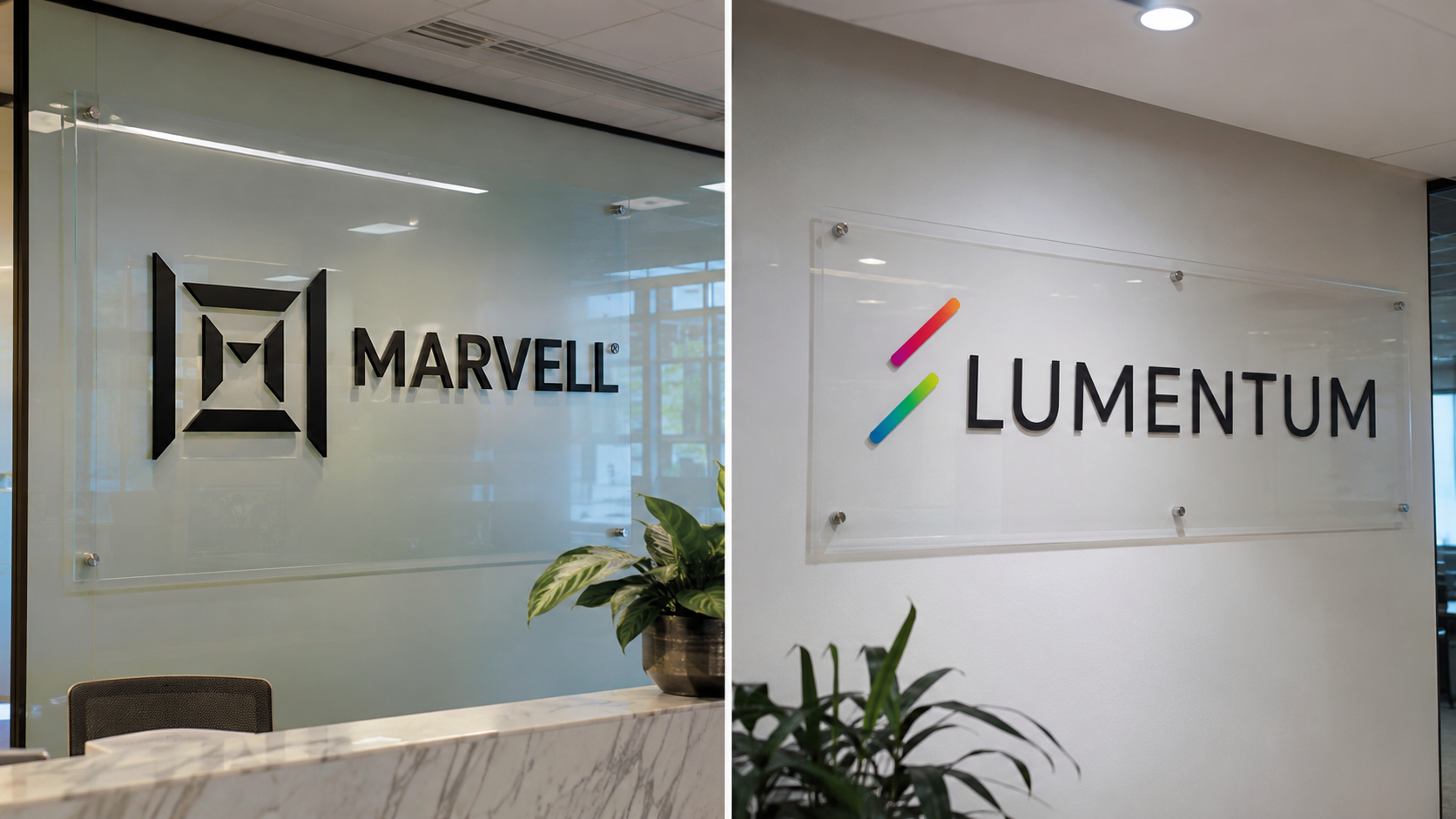
Marvell Technology has agreed to acquire data-centre optics maker Lumentum in an all-stock transaction worth roughly $115 billion, including debt, making it one of the largest corporate bets on the artificial intelligence infrastructure boom.
The transaction will be financed entirely through stock.
Under the terms of the agreement announced on Monday, Lumentum shareholders will receive 4.5 shares of Marvell common stock for each share they own.
The deal implies a value of about $1,132 for each Lumentum share, representing a 24% premium to its closing price on October 28, before speculation about a possible combination between the companies began circulating.
Marvell shares MRVL fell over 3% after the market opened on Monday following the announcement, while Lumentum shares also fell about 8%.
The acquisition comes as Marvell seeks to expand its presence in the rapidly growing AI infrastructure market and strengthen its competitive position against larger rival Broadcom.
The combination would bring together two companies developing technologies that are increasingly important to the construction of AI data centres, where the ability to move enormous volumes of data quickly and efficiently is becoming a critical requirement.
Marvell expands its AI infrastructure ambitions
The acquisition reflects Marvell’s growing conviction that spending on AI infrastructure will remain strong for years, supporting demand for specialised chips and the networking technologies needed to connect them.
Marvell designs custom AI chips, networking processors and other technologies that connect computing systems and move data across data centres.
Lumentum, meanwhile, makes lasers, semiconductor components and optical interconnectivity hardware used in data-centre servers.
Its products belong to the field of photonics, which uses light rather than traditional electrical signals to transmit information.
The technology is gaining importance as data centres require faster connections between processors, servers and other computing components.
Traditional copper-based connections face limitations as data transmission requirements increase.
Optical technologies could help address those constraints while improving speed and energy efficiency.
“AI infrastructure is undergoing a fundamental architectural shift toward optical connectivity, creating an opportunity that comes along once in a generation,” Marvell Chief Executive Matt Murphy said.
He added that the acquisition would help shape the next era of AI connectivity.
Marvell’s growing exposure to data-centre infrastructure marks a significant shift in its business over the past decade.
Its data-centre segment accounted for less than 10% of revenue in 2016 but has since become its largest business and primary growth engine.
Murphy has previously described the company’s commitment to developing its data-centre operations as having “bet the farm”.
Lumentum has a market capitalisation of approximately $76 billion, compared with Marvell’s roughly $172 billion.
Nvidia investments link both companies
The transaction also brings together two companies that have attracted strategic investment from Nvidia, the dominant supplier of AI accelerators.
In early March, Nvidia announced a multiyear purchase commitment for Lumentum’s advanced laser components.
As part of the arrangement, Nvidia said it would invest $2 billion in the company to support research and development and expand its manufacturing capabilities in the US.
Later that month, Nvidia invested another $2 billion in Marvell through a strategic partnership intended to help developers of custom AI chips connect more easily with Nvidia’s systems.
Marvell is known for helping develop custom AI processors for Amazon Web Services.
It has also expanded its relationship with Google, disclosing an expanded commercial partnership in August that gave the search giant rights to purchase Marvell shares.
The acquisition could give Marvell a broader portfolio of technologies to serve customers building AI infrastructure, including hardware that competes with Nvidia’s own offerings.
Marvell said the acquisition would expand the combined company’s total addressable market to $550 billion.
Broadcom rivalry adds another dimension
The acquisition could strengthen Marvell’s challenge to Broadcom, which has long been Google’s principal partner for custom AI processors and offers a wider range of data-centre hardware.
Marvell secured a significant opportunity in August when it signed an agreement to supply chips that work alongside Google’s AI processors.
The arrangement could generate up to $120 billion in sales through fiscal 2033 and gave Google the right to acquire a $12.2 billion stake in the company.
Adding Lumentum’s optical technologies could allow Marvell to offer customers a more integrated combination of custom processors, networking equipment and high-speed connectivity components.
Lumentum reports earnings beat in Q1
Lumentum reported adjusted earnings of $4.57 per share for the fiscal first quarter, beating analysts’ estimates of $4.22.
Revenue surged 136% year over year to $1.26 billion, also exceeding market expectations.
The company expects revenue for the fiscal second quarter to range between $1.575 billion and $1.625 billion, well above analysts’ consensus estimate of $1.48 billion.
Adjusted earnings are forecast to come in between $5.90 and $6.20 per share.
Profitability and valuation remain key questions
The acquisition’s financial implications will be closely watched as Marvell takes on a substantially larger business with different margin characteristics.
“Combining Marvell’s custom chips and networking expertise with Lumentum’s optical components could give it a much stronger hand as data centers demand ever-faster, more energy-efficient connections,” said Axel Rudolph, chief technical analyst at IG Group.
“But this is an enormous bet, and investors are right to ask whether Marvell is paying too much and taking on too much at once.”
An all-stock transaction could initially dilute Marvell shareholders, as the earnings contribution from the acquisition may not be sufficient to offset the impact of issuing additional shares, Stifel analyst Tore Svanberg told MarketWatch.
However, he expects investors to benefit over time as cost savings from the combined businesses begin to materialise.
Svanberg said investors were “freaking out” over the potential scale of the transaction and the regulatory hurdles involved.
Any merger would require approval from authorities in both the US and China, with the Chinese review process potentially proving lengthy.
Experts said the acquisition premium was another source of concern for investors.
Stifel, which reiterated a Buy rating and a $370 price target on Marvell stock last week following reports of advanced acquisition discussions, identified several potential strategic benefits.
These include the development of system-level products, closer integration across AI networking infrastructure, expansion into integrated optics, and securing a larger supply of lasers and optical components.
The brokerage also highlighted the opportunity to build a scaled US-based transceiver supplier amid the possibility of restrictions on Chinese optical module suppliers.
However, Lumentum currently operates with a gross margin of 44.24% and remains unprofitable on a trailing 12-month basis, although analysts expect it to return to profitability this year.
Stifel said the acquisition would initially dilute Marvell’s gross margin but expected it to remain within the company’s long-term target range of 56% to 59%.
The brokerage also expects the transaction to be immediately accretive to Marvell’s non-GAAP operating margin.
It argued that the development of system-level products could eventually help restore gross margins towards Marvell’s corporate average while expanding its total addressable market.
The post Marvell to buy Lumentum in $115B deal: why are MRVL and LITE stocks falling? appeared first on Invezz
